
Water-Gas Shift Reaction on Pt(111)
This tutorial shows how to translate a typical Zacros workflow to pyZacros. To do this, we will look at the water-gas shift reaction on Pt(111). The required physical/chemical descriptions of the system have been published in the literature.
This example shows how to include gas species, transition states, as well as stable surface species, and the lateral interactions between them. All information about the energetics was obtained via density functional theory (DFT) calculations. Importantly, lateral interactions are also discussed and included in the example script.
The script can be downloaded through this link: WaterGasShiftOnPt111.py
The following section will discuss the structure of the script step-by-step. You can also skip ahead to check out the results of the simulation.
pyZacros Setup
A pyZacros script always starts by loading the pyZacros module. For this example, we also define the pz alias in order to quickly access the necessary functions.
1import scm
2import scm.pyzacros as pz
We then proceed by defining the chemical species that make up the reaction system. This is done using the Species API. By default, the reference energy is set to 0. By including an * in the name of a species, they are automatically designated as an adsorbate.
 1# ---------------------------------------------
 2# Species:
 3# ---------------------------------------------
 4# - Gas-species:
 5CO_gas = pz.Species("CO")
 6H2O_gas = pz.Species("H2O")
 7H2_gas = pz.Species("H2")
 8CO2_gas = pz.Species("CO2", gas_energy=-0.615)
 9O2_gas = pz.Species("O2", gas_energy=4.913)
10
11# - Surface species:
12s0 = pz.Species("*", 1) # Empty adsorption site
13CO_adsorbed = pz.Species("CO*", 1)
14H2O_adsorbed = pz.Species("H2O*", 1)
15OH_adsorbed = pz.Species("OH*", 1)
16O_adsorbed = pz.Species("O*", 1)
17H_adsorbed = pz.Species("H*", 1)
18COOH_adsorbed = pz.Species("COOH*", 1)
For constructing the lattice, we will use the built-in hexagonal lattice provided by pyZacros:
1# ---------------------------------------------
2# Lattice setup:
3# ---------------------------------------------
4latt = pz.Lattice(lattice_type=pz.Lattice.HEXAGONAL, lattice_constant=1.0, repeat_cell=[8, 10])
Now that we have a lattice, we can proceed by writing down the adsorption energies and the lateral interactions. For this example, we will limit ourselves to a small selection of nearest-neighbor interactions. Our set of cluster energies is then collected in a ClusterExpansion. This is a special Python list that allows us to more conveniently access the cluster energies.
 1# ---------------------------------------------
 2# Clusters:
 3# ---------------------------------------------
 4CO_point = pz.Cluster(species=[CO_adsorbed], energy=-2.077, label="CO_point")
 5H2O_point = pz.Cluster(species=[H2O_adsorbed], energy=-0.362, label="H2O_point")
 6OH_point = pz.Cluster(species=[OH_adsorbed], energy=0.830, label="OH_point")
 7O_point = pz.Cluster(species=[O_adsorbed], energy=1.298, label="O_point")
 8H_point = pz.Cluster(species=[H_adsorbed], energy=-0.619, label="H_point")
 9COOH_point = pz.Cluster(species=[COOH_adsorbed], energy=-1.487, label="COOH_point")
10
11CO_pair_1NN = pz.Cluster(species=[CO_adsorbed, CO_adsorbed], neighboring=[(0, 1)], energy=0.560, label="CO_pair_1NN")
12OH_H_1NN = pz.Cluster(species=[OH_adsorbed, H_adsorbed], neighboring=[(0, 1)], energy=0.021, label="OH_H_1NN")
13O_H_1NN = pz.Cluster(species=[O_adsorbed, H_adsorbed], neighboring=[(0, 1)], energy=0.198, label="O_H_1NN")
14CO_OH_1NN = pz.Cluster(species=[CO_adsorbed, OH_adsorbed], neighboring=[(0, 1)], energy=0.066, label="CO_OH_1NN")
15CO_O_1NN = pz.Cluster(species=[CO_adsorbed, O_adsorbed], neighboring=[(0, 1)], energy=0.423, label="CO_O_1NN")
16
17# ---------------------------------------------
18# Cluster expansion:
19# ---------------------------------------------
20myClusterExpansion = pz.ClusterExpansion()
21myClusterExpansion.extend([CO_point, H2O_point])
22myClusterExpansion.append(OH_point)
23myClusterExpansion.extend([O_point, H_point, COOH_point])
24myClusterExpansion.extend([CO_pair_1NN, OH_H_1NN, O_H_1NN, CO_OH_1NN, CO_O_1NN])
The reaction mechanism is constructed by writing out the elementary steps. For each reaction, we define the reactants and products, the reversibility, and the kinetic parameters. (Note how the parameter names match those found in the Zacros input files.)
  1# ---------------------------------------------
  2# Elementary Reactions
  3# ---------------------------------------------
  4CO_adsorption = pz.ElementaryReaction(
  5    initial=[s0, CO_gas],
  6    final=[CO_adsorbed],
  7    reversible=True,
  8    pre_expon=2.226e007,
  9    pe_ratio=2.137e-006,
 10    activation_energy=0.0,
 11    label="CO_adsorption",
 12)
 13
 14H2_dissoc_adsorp = pz.ElementaryReaction(
 15    initial=[s0, s0, H2_gas],
 16    final=[H_adsorbed, H_adsorbed],
 17    neighboring=[(0, 1)],
 18    reversible=True,
 19    pre_expon=8.299e007,
 20    pe_ratio=7.966e-006,
 21    activation_energy=0.0,
 22    label="H2_dissoc_adsorp",
 23)
 24
 25H2O_adsorption = pz.ElementaryReaction(
 26    initial=[s0, H2O_gas],
 27    final=[H2O_adsorbed],
 28    reversible=True,
 29    pre_expon=2.776e002,
 30    pe_ratio=2.665e-006,
 31    activation_energy=0.0,
 32    label="H2O_adsorption",
 33)
 34
 35H2O_dissoc_adsorp = pz.ElementaryReaction(
 36    initial=[H2O_adsorbed, s0],
 37    final=[OH_adsorbed, H_adsorbed],
 38    neighboring=[(0, 1)],
 39    reversible=True,
 40    pre_expon=1.042e13,
 41    pe_ratio=1.000e00,
 42    activation_energy=0.777,
 43    label="H2O_dissoc_adsorp",
 44)
 45
 46OH_decomposition = pz.ElementaryReaction(
 47    initial=[s0, OH_adsorbed],
 48    final=[O_adsorbed, H_adsorbed],
 49    neighboring=[(0, 1)],
 50    reversible=True,
 51    pre_expon=1.042e13,
 52    pe_ratio=1.000e00,
 53    activation_energy=0.940,
 54    label="OH_decomposition",
 55)
 56
 57COOH_formation = pz.ElementaryReaction(
 58    initial=[CO_adsorbed, OH_adsorbed],
 59    final=[s0, COOH_adsorbed],
 60    neighboring=[(0, 1)],
 61    reversible=True,
 62    pre_expon=1.042e13,
 63    pe_ratio=1.000e00,
 64    activation_energy=0.405,
 65    label="COOH_formation",
 66)
 67
 68COOH_decomposition = pz.ElementaryReaction(
 69    initial=[COOH_adsorbed, s0],
 70    final=[s0, H_adsorbed, CO2_gas],
 71    neighboring=[(0, 1)],
 72    reversible=False,
 73    pre_expon=1.042e13,
 74    activation_energy=0.852,
 75    label="COOH_decomposition",
 76)
 77
 78CO_oxidation = pz.ElementaryReaction(
 79    initial=[CO_adsorbed, O_adsorbed],
 80    final=[s0, s0, CO2_gas],
 81    neighboring=[(0, 1)],
 82    reversible=False,
 83    pre_expon=1.042e13,
 84    activation_energy=0.988,
 85    label="CO_oxidation",
 86)
 87
 88# ---------------------------------------------
 89# Full mechanism:
 90# ---------------------------------------------
 91mech = pz.Mechanism(
 92    [
 93        CO_adsorption,
 94        H2_dissoc_adsorp,
 95        H2O_adsorption,
 96        H2O_dissoc_adsorp,
 97        OH_decomposition,
 98        COOH_formation,
 99        COOH_decomposition,
100        CO_oxidation
101    ]
102)
Lastly, we define the general simulation settings. By creating a Settings object, we automatically load the default Zacros parameters. For this tutorial, we will use a short simulation time in order to quickly see the results of our simulation.
 1# ---------------------------------------------
 2# Settings:
 3# ---------------------------------------------
 4sett = pz.Settings()
 5
 6sett.molar_fraction.CO = 1.0e-5
 7sett.molar_fraction.H2O = 0.950
 8
 9sett.random_seed = 123278
10sett.temperature = 500.0
11sett.pressure = 10.0
12sett.snapshots = ("time", 5.0e-4)
13sett.process_statistics = ("time", 5.0e-4)
14sett.species_numbers = ("time", 5.0e-4)
15sett.event_report = "off"
16sett.max_steps = "infinity"
17sett.max_time = 0.25
When we want to run a pyZacros job, we first start up Zacros itself by using the init() call. We then collect all of our settings into a ZacrosJob. The example script uses the print function to now show you an overview of the final settings, using the familiar Zacros input format (shown below).
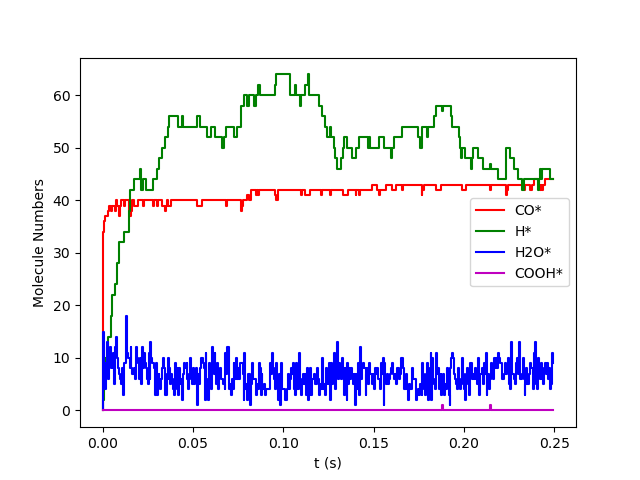
The run function is used to start the actual Zacros simulation. Once the job has finished, we can use one of the built-in post-processing functions to plot the transient profiles for our key reaction species.
 1scm.pyzacros.init()
 2
 3job = pz.ZacrosJob(settings=sett, lattice=latt, mechanism=mech, cluster_expansion=myClusterExpansion)
 4
 5print(job)
 6results = job.run()
 7
 8if job.ok():
 9    results.plot_molecule_numbers(["CO*", "H*", "H2O*", "COOH*"])
10
11scm.pyzacros.finish()
The finish() call is used to wrap up the Zacros job and close the script.
Running the Simulation
pyZacros scripts are executed using PLAMS. The PLAMS documentation contains examples for running Python workflows on Windows, Linux and MacOS systems. If you are using the default AMS installation:
$AMSBIN/amspython WaterGasShiftOnPt111.py
The script will first print an overview of the provided simulation parameters.
The actual simulation (denoted by the plamsjob) will then start running. This example script only runs for a very short time, and should finish in under 1 minute.
A figure will be shown at the end of the simulation, containing the transient composition of surface species.
  1$ amspython WaterGasShiftOnPt111.py
  2PLAMS working folder: /home/user/pyzacros/examples/WaterGasShiftOnPt111/plams_workdir
  3---------------------------------------------------------------------
  4simulation_input.dat
  5---------------------------------------------------------------------
  6random_seed         123278
  7temperature          500.0
  8pressure              10.0
  9
 10snapshots                 on time       0.0005
 11process_statistics        on time       0.0005
 12species_numbers           on time       0.0005
 13event_report      off
 14max_steps         infinity
 15max_time          0.25
 16
 17n_gas_species    4
 18gas_specs_names              CO           H2          H2O          CO2
 19gas_energies        0.00000e+00  0.00000e+00  0.00000e+00 -6.15000e-01
 20gas_molec_weights   2.79949e+01  2.01560e+00  1.80105e+01  4.39898e+01
 21gas_molar_fracs     1.00000e-05  0.00000e+00  9.50000e-01  0.00000e+00
 22
 23n_surf_species    6
 24surf_specs_names         CO*        H*      H2O*       OH*        O*     COOH*
 25surf_specs_dent            1         1         1         1         1         1
 26
 27finish
 28---------------------------------------------------------------------
 29lattice_input.dat
 30---------------------------------------------------------------------
 31lattice default_choice
 32  hexagonal_periodic 1.0 8 10
 33end_lattice
 34---------------------------------------------------------------------
 35energetics_input.dat
 36---------------------------------------------------------------------
 37energetics
 38
 39cluster CO_point
 40  sites 1
 41  lattice_state
 42    1 CO* 1
 43  site_types 1
 44  graph_multiplicity 1
 45  cluster_eng -2.07700e+00
 46end_cluster
 47
 48cluster H2O_point
 49  sites 1
 50  lattice_state
 51    1 H2O* 1
 52  site_types 1
 53  graph_multiplicity 1
 54  cluster_eng -3.62000e-01
 55end_cluster
 56
 57cluster OH_point
 58  sites 1
 59  lattice_state
 60    1 OH* 1
 61  site_types 1
 62  graph_multiplicity 1
 63  cluster_eng  8.30000e-01
 64end_cluster
 65
 66cluster O_point
 67  sites 1
 68  lattice_state
 69    1 O* 1
 70  site_types 1
 71  graph_multiplicity 1
 72  cluster_eng  1.29800e+00
 73end_cluster
 74
 75cluster H_point
 76  sites 1
 77  lattice_state
 78    1 H* 1
 79  site_types 1
 80  graph_multiplicity 1
 81  cluster_eng -6.19000e-01
 82end_cluster
 83
 84cluster COOH_point
 85  sites 1
 86  lattice_state
 87    1 COOH* 1
 88  site_types 1
 89  graph_multiplicity 1
 90  cluster_eng -1.48700e+00
 91end_cluster
 92
 93cluster CO_pair_1NN
 94  sites 2
 95  neighboring 1-2
 96  lattice_state
 97    1 CO* 1
 98    2 CO* 1
 99  site_types 1 1
100  graph_multiplicity 1
101  cluster_eng  5.60000e-01
102end_cluster
103
104cluster OH_H_1NN
105  sites 2
106  neighboring 1-2
107  lattice_state
108    1 OH* 1
109    2 H* 1
110  site_types 1 1
111  graph_multiplicity 1
112  cluster_eng  2.10000e-02
113end_cluster
114
115cluster O_H_1NN
116  sites 2
117  neighboring 1-2
118  lattice_state
119    1 O* 1
120    2 H* 1
121  site_types 1 1
122  graph_multiplicity 1
123  cluster_eng  1.98000e-01
124end_cluster
125
126cluster CO_OH_1NN
127  sites 2
128  neighboring 1-2
129  lattice_state
130    1 CO* 1
131    2 OH* 1
132  site_types 1 1
133  graph_multiplicity 1
134  cluster_eng  6.60000e-02
135end_cluster
136
137cluster CO_O_1NN
138  sites 2
139  neighboring 1-2
140  lattice_state
141    1 CO* 1
142    2 O* 1
143  site_types 1 1
144  graph_multiplicity 1
145  cluster_eng  4.23000e-01
146end_cluster
147
148end_energetics
149---------------------------------------------------------------------
150mechanism_input.dat
151---------------------------------------------------------------------
152mechanism
153
154reversible_step CO_adsorption
155  gas_reacs_prods CO -1
156  sites 1
157  initial
158    1 * 1
159  final
160    1 CO* 1
161  site_types 1
162  pre_expon  2.22600e+07
163  pe_ratio  2.13700e-06
164  activ_eng  0.00000e+00
165end_reversible_step
166
167reversible_step H2_dissoc_adsorp
168  gas_reacs_prods H2 -1
169  sites 2
170  neighboring 1-2
171  initial
172    1 * 1
173    2 * 1
174  final
175    1 H* 1
176    2 H* 1
177  site_types 1 1
178  pre_expon  8.29900e+07
179  pe_ratio  7.96600e-06
180  activ_eng  0.00000e+00
181end_reversible_step
182
183reversible_step H2O_adsorption
184  gas_reacs_prods H2O -1
185  sites 1
186  initial
187    1 * 1
188  final
189    1 H2O* 1
190  site_types 1
191  pre_expon  2.77600e+02
192  pe_ratio  2.66500e-06
193  activ_eng  0.00000e+00
194end_reversible_step
195
196reversible_step H2O_dissoc_adsorp
197  sites 2
198  neighboring 1-2
199  initial
200    1 H2O* 1
201    2 * 1
202  final
203    1 OH* 1
204    2 H* 1
205  site_types 1 1
206  pre_expon  1.04200e+13
207  pe_ratio  1.00000e+00
208  activ_eng  7.77000e-01
209end_reversible_step
210
211reversible_step OH_decomposition
212  sites 2
213  neighboring 1-2
214  initial
215    1 * 1
216    2 OH* 1
217  final
218    1 O* 1
219    2 H* 1
220  site_types 1 1
221  pre_expon  1.04200e+13
222  pe_ratio  1.00000e+00
223  activ_eng  9.40000e-01
224end_reversible_step
225
226reversible_step COOH_formation
227  sites 2
228  neighboring 1-2
229  initial
230    1 CO* 1
231    2 OH* 1
232  final
233    1 * 1
234    2 COOH* 1
235  site_types 1 1
236  pre_expon  1.04200e+13
237  pe_ratio  1.00000e+00
238  activ_eng  4.05000e-01
239end_reversible_step
240
241step COOH_decomposition
242  gas_reacs_prods CO2 1
243  sites 2
244  neighboring 1-2
245  initial
246    1 COOH* 1
247    2 * 1
248  final
249    1 * 1
250    2 H* 1
251  site_types 1 1
252  pre_expon  1.04200e+13
253  activ_eng  8.52000e-01
254end_step
255
256step CO_oxidation
257  gas_reacs_prods CO2 1
258  sites 2
259  neighboring 1-2
260  initial
261    1 CO* 1
262    2 O* 1
263  final
264    1 * 1
265    2 * 1
266  site_types 1 1
267  pre_expon  1.04200e+13
268  activ_eng  9.88000e-01
269end_step
270
271end_mechanism
272[08.02|15:34:32] JOB plamsjob STARTED
273[08.02|15:34:32] JOB plamsjob RUNNING
274[08.02|15:34:57] JOB plamsjob FINISHED
275[08.02|15:34:57] JOB plamsjob SUCCESSFUL
276[08.02|15:35:10] PLAMS run finished. Goodbye