
ROKS-TDA-SOC
This tutorial requires AMS2026 or later.
The perturbative method ROKS-TDA-SOC method, described in Refs. [1] [2], is a method to deal with the influence of spin-orbit coupling (SOC) on the excitation energies for open-shell systems. In this method, first, the scalar relativistic excited states, with well defined spin, are calculated by means of time-dependent density funcitonal theory (TD-DFT) using a restricted open-shell Kohn–Sham (ROKS) framework, as well as applying the Tamm–Dancoff approximation (TDA). Next, in the basis of these ROKS-TDA states, SOC is included, which in total defines the ROKS-TDA-SOC method.
In this Tutorial ROKS-TDA-SOC is used for a few systems as described in Refs. [1] [2].
Remark: All systems calculated in the Tutorial contain some symmetry. These symmetries may have multi-dimensional irreps, in which case one can expect degeneracies in the excited state energies. In the ROKS-TDA-SOC implementation in ADF, however, symmetry can not be used. To preserve degeneracy also in calculations in which no symmetry is used it is required that all subspecies of an irrep for a given excited state are calculated (included). This means that one should choose the number of wanted excitations wisely (which is done is this Tutorial). One may have to iterate over the number of wanted excited states, if one does not observe the expected degeneracies. One may also first do ROKS-TDA calculations, thus without perturbative SOC, in which one can use higher symmetries. Note that numerical issues may also lift degeneracies. The symmetry labels labels are not deduced here, but are taken over from Refs. [1] [2].
Second remark: The choice of the XC functional will not be discussed here, see Refs. [1] [2] for more details. Here we pick one of the XC-functionals that is used in these papers for a certain system. The calculations will take much more time if one uses a hybrid functional instead of an LDA or GGA.
Au
The gold atom was investigated in Ref. [1] which has a 2S1/2 (doublet) ground state. The spin-orbit splitting between the lowest 2D3/2 and 2D5/2 excited states was calculated. LDA is used with a QZ4P basis set.
 button: symmetry should be ATOM
 panel
panel1.0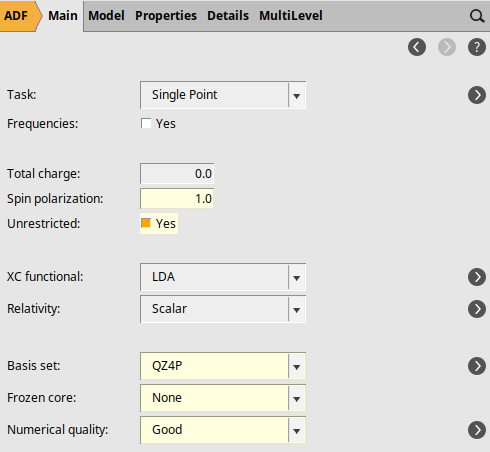
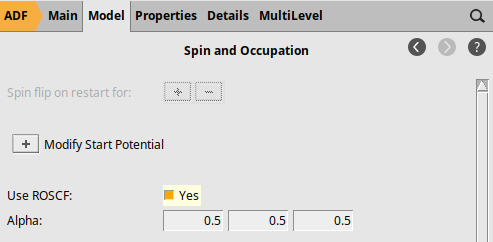
8 doublet (same spin as ground state, SS) and 15 quartet (spin up, SU) excited states are taken as basis for the ROKS-TDA-SOC calculation.
8 15 for the ‘Number of excitations`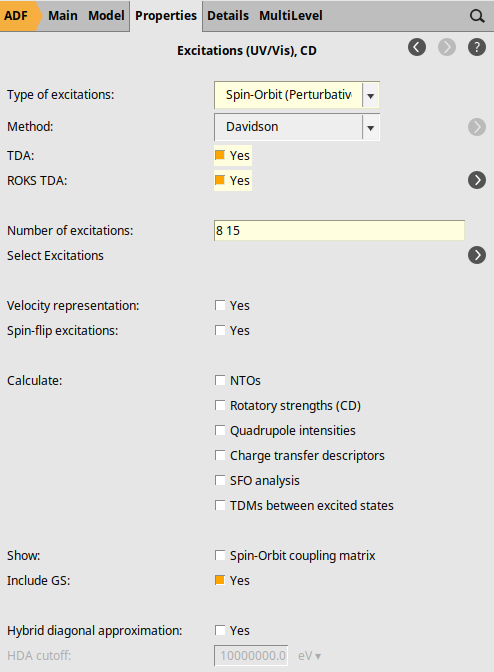
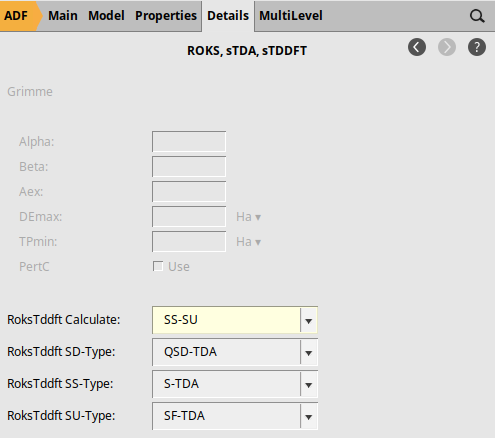
Results can be viewed with AMSspecta.
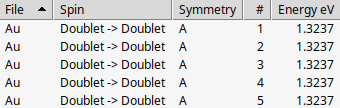
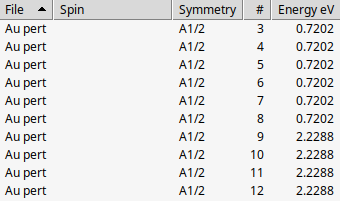
The scalar relativistic 2D excited state (2 times 5 is 10-fold degenerate, at 1.32 eV) is split by SOC into a 2D5/2 excited state (6-fold degeneracy, at 0.72 eV) and a 2D3/2 excited state (4-fold degeneracy, at 2.23 eV). The SOC-splitting \(\Delta\) = 2.23 - 0.72 = 1.51 eV.
Remark: The basis set convergence of (the spin-orbit splitting of) the 2D (5d96s2) excited state is fast, since one already needs a good description of the 5d- and 6s-orbital in the ground state. For example, using a TZ2P basis set would also give reasonable numbers.
ZnCH3
ZnCH3 was investigated in Ref. [1] which has a 2A1 (doublet) ground state and a lowest 2E excited state. The SOC splitting of 2E state into a 2E1/2 and a 2E3/2 state was calculated. In the ground state as well as in the lowest excited state the unpaired electron is mostly located at the Zn atom. The hybrid functional BHandH is used with a QZ4P basis set on the Zn atom and a TZ2P basis set on the other atoms.
The geometry of ZnCH3 was optimized using B3LYP with a TZ2P all electron basis set:
C       0.00000000       0.00000000       0.00000000
Zn      0.00000000       0.00000000       2.05000000
H      -0.51875000      -0.89850136      -0.33000000
H      -0.51875000       0.89850136      -0.33000000
H       1.03750000       0.00000000      -0.33000000
button: symmetry should be C(3v)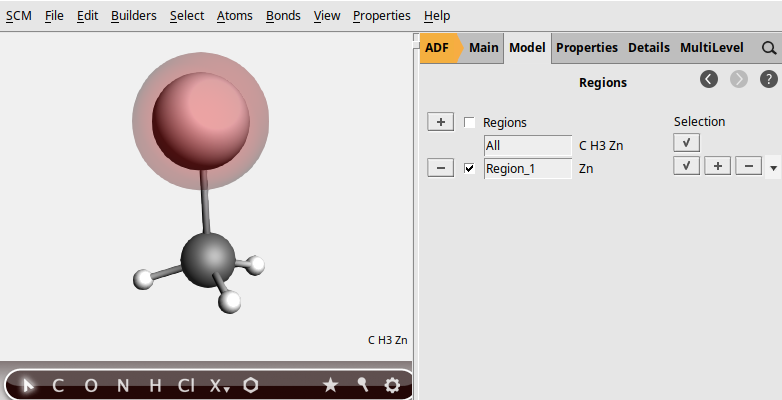
This region will be used to define a larger basis set for the Zn atom than for the rest of the molecule.
panel1.0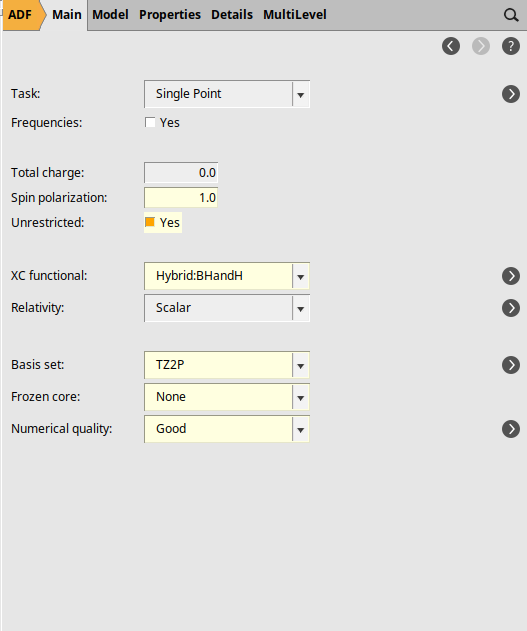
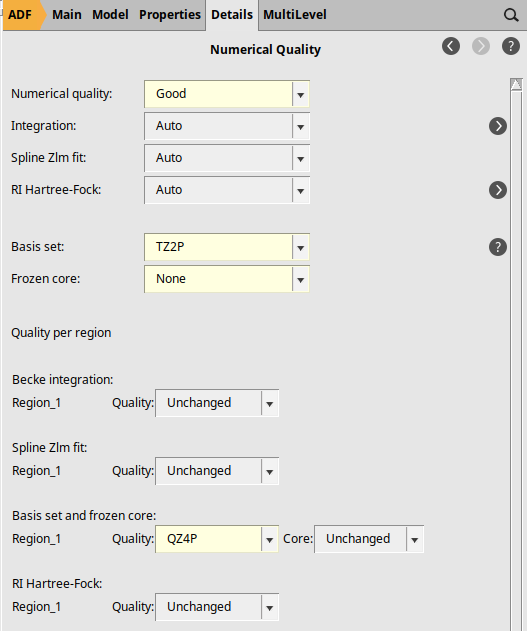
5 doublet (same spin as ground state, SS) and 2 quartet (spin up, SU) excited states are taken as basis for the ROKS-TDA-SOC calculation.
5 2 for the ‘Number of excitations`
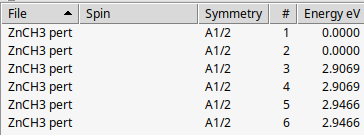
The scalar relativistic 2E excited state (2 times 2 is 4-fold degenerate, at 2.93 eV) is split by SOC into a 2E1/2 excited state (2-fold degeneracy, at 2.91 eV) and a 2E3/2 excited state (2-fold degeneracy, at 2.95 eV). The SOC-splitting \(\Delta\) = 2.95 - 2.91 = 0.04 eV.
Remark: The basis set convergence of (the small spin-orbit splitting of) the 2E excited state is slow, since this is more like a Rydberg state. Using a TZ2P basis set on the Zn atom would give different numbers.
TeSe
The diatomic SeTe was investigated in Ref. [2] which has a X \(³\Sigma^{-}\) (triplet) ground state and low a \(¹\Delta\) and b \(¹\Sigma^{+}\) (singlet) excited states. SOC splits these states into a X1 0+ ground state, and low X2 1, a 2, and b 0+ excited states. The energetic difference between X1 0+ and X2 1 is usually called the zero-field splitting (ZFS). PBE is used with a TZ2P basis set.
button: symmetry should be C(lin) panel2.0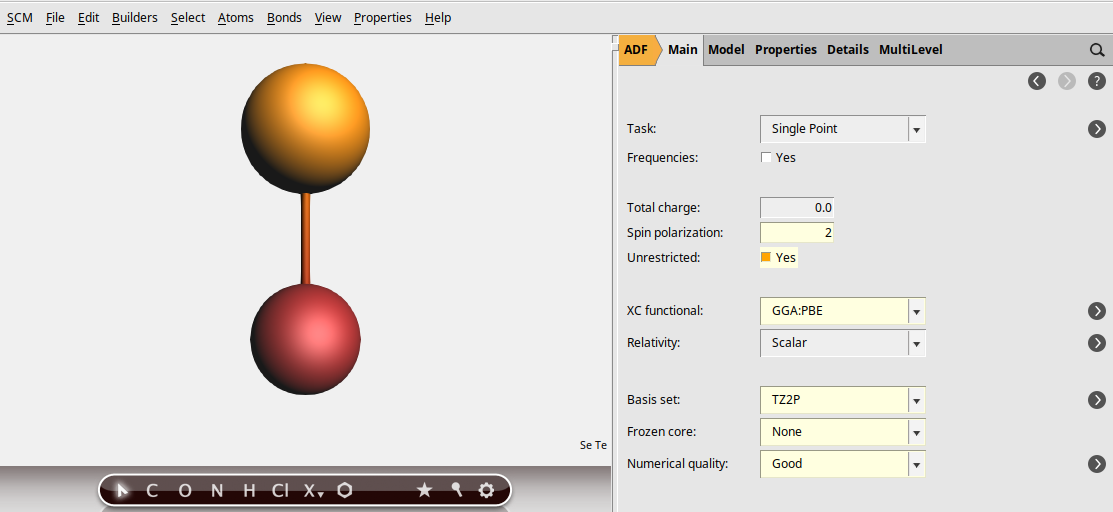
14 singlet (spin down, SD), 13 triplet (same spin as ground state, SS) and 3 quintet (spin up, SU) excited states are taken as basis for the ROKS-TDA-SOC calculation.
14 13 3 for the ‘Number of excitations`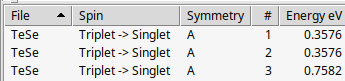
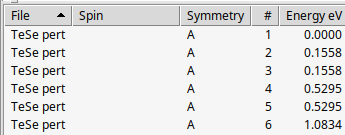
The scalar relativistic X \(³\Sigma^{-}\) (3-fold degeneracy, at 0 eV) ground state, the a \(¹\Delta\) (2-fold degeneracy, at 0.36 eV) and b \(¹\Sigma^{+}\) (no degeneracy, at 0.76 eV) are split by SOC into a X1 0+ ground state (no degeneracy, at 0 eV), X2 1 (2-fold degeneracy, at 0.16 eV), a 2 (2-fold degeneracy, ata 0.53 eV), and b 0+ (no degenaracy, at 1.08 eV) excited states. The ZFS is thus calculated to be 0.16 eV.
OsCl6-
The octahedral OsCl6- was investigated in Ref. [2] which has a 4A2g (quartet) ground state, and low 2Eg, 2T1g, and 2T2g (doublet) excited states, all having a high Os 5d3 character. The states are split by SOC into the 0 \(\Gamma_{8g}\), 1 \(\Gamma_{8g}\), 2 \(\Gamma_{8g}\), 1 \(\Gamma_{6g}\), 1 \(\Gamma_{7g}\), and 3 \(\Gamma_{8g}\) states.
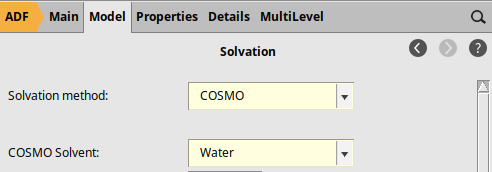
PBE is used with a TZ2P basis set. Like was done in Ref. [2] the conductor-like screening model (COSMO) was used to suppress numerical instabilities due to highly diffuse orbitals in the case of negatively charged complexes. The geometry is taken from Ref. [2].
Os   0.00   0.00   0.00
Cl   2.28   0.00   0.00
Cl   0.00   2.28   0.00
Cl   0.00   0.00   2.28
Cl  -2.28   0.00   0.00
Cl   0.00  -2.28   0.00
Cl   0.00   0.00  -2.28
button: symmetry should be O(h) panel-1.03.0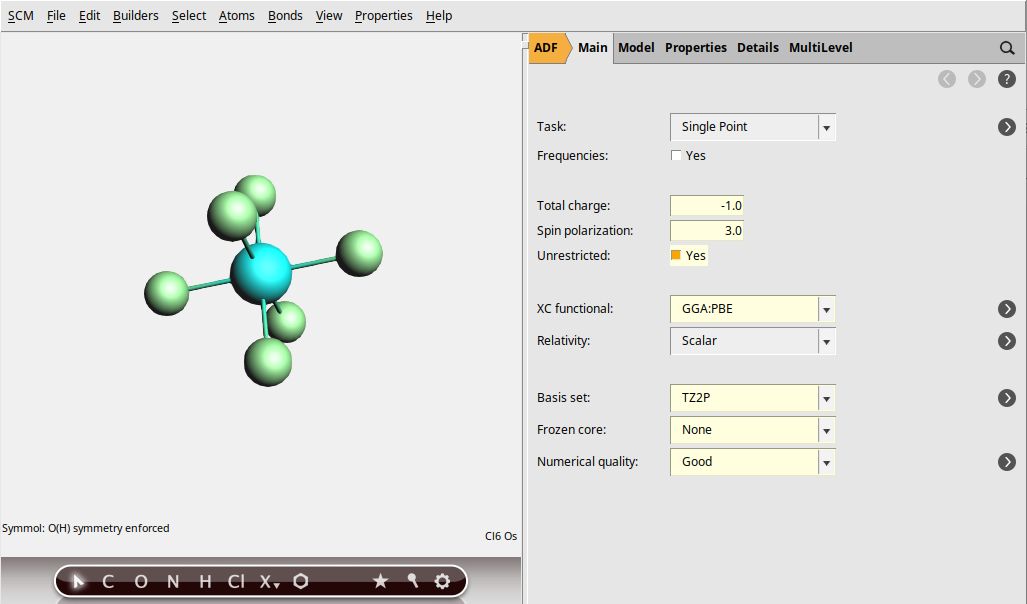
8 doublet (spin down, SD) excited states are taken as basis for the ROKS-TDA-SOC calculation.
8 for the ‘Number of excitations`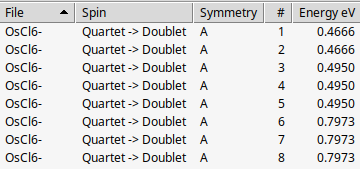
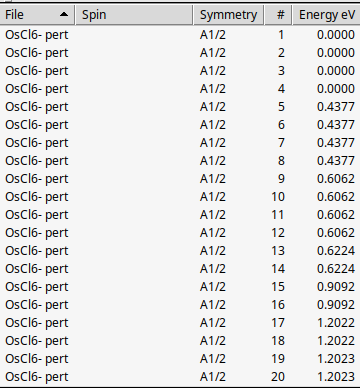
The scalar relativistic 4A2g (4-fold degeneracy, at 0 eV) ground state, and 2Eg (2 times 2 is 4-fold degenerate, at 0.47 eV), 2T1g (2 times 3 is 6-fold degenerate, at 0.50 eV), and 2T2g (2 times 3 is 6-fold degenerate, at 0.80 eV) excited states are split by SOC into a 0 \(\Gamma_{8g}\) ground state (4-fold degeneracy, at 0 eV), and 1 \(\Gamma_{8g}\) (4-fold degeneracy, at 0.44 eV), 2 \(\Gamma_{8g}\) (4-fold degeneracy, at 0.61 eV), 1 \(\Gamma_{6g}\) (2-fold degeneracy, at 0.62 eV), 1 \(\Gamma_{7g}\) (2-fold degeneracy, at 0.91 eV), and 3 \(\Gamma_{8g}\) (4-fold degeneracy, at 1.20 eV) excited states.