
Amorphous Disorder
The disordered nature of typical OLED materials gives rise to a diversity in molecular environments. This diversity is accounted for by including e.g. energy level broadening and is an important feature in describing charge transport inside the device.
The description of the molecular disorder can have a strong impact on the simulated performance. Various settings are provided to customize the disorder character. Distribution functions for the polaron/exciton energies have been discussed in the basic tutorials. This tutorial will cover methods for introducing spatial correlation between molecular energy levels.
Correlations between Molecular Energy Levels
Energy level distributions are typically specified for HOMO, LUMO, singlet and triplet energy levels in order to model the variations in energy levels due to amorphous disorder in the molecular environment. By default, the distributions of the HOMO and LUMO energies are treated as being uncorrelated. The HOMO shift and the LUMO shift are then computed independently from one another. This behavior is exhibited by the majority of OLED materials.
Some materials can exhibit a correlated HOMO-LUMO shift, resulting in small-bandwidth emission. This is typically observed when the HOMO or LUMO wavefunction is shielded on the center of the molecule, resulting in limited interaction with the polarized environment. Anti-correlated HOMO-LUMO shifts, meanwhile, are typically observed for molecules with torsional disorder.
The HOMO-LUMO correlation can be set in the Parameters → Volume → Energy Landscape → HOMO and LUMO Correlation field.
Correlated will link the shifts in the HOMO and LUMO levels.
Anticorrelated will make the shift in the HOMO level opposite to the shift in the LUMO level.

Fig. 134 Configuration of energy level shifts in the parameter set
Note
The magnitude of the energy level shifts may still differ between HOMO and LUMO, according to the distributions that have been specified in the Materials page.
Exciton energies can be correlated to the HOMO-LUMO shifts. The change in exciton binding energy is then scaled to be proportional to the change in band gap. Select the Correlate polaron and exciton levels option to enable this behavior.
Exciton energies can be correlated to the HOMO-LUMO shifts. This behavior occurs when the singlet/triplet wavefunctions resemble the LUMO, which can typically be characterized by a small binding energy. Correlation between the polaron and exciton energy can be enabled through the Correlate polaron and exciton levels option. The change in exciton binding energy is then scaled to be proportional to the change in the band gap.
Note
Be default, the exciton energy levels and the exciton binding energies are linked together in order to maintain thermodynamic consistency. The exciton energy levels and the exciton binding energies can also be decoupled (Parameters → Advanced → Propagate exciton shifts to binding energy). The shifts in the exciton energy levels are then instead applied to the exciton binding energies, which may be relevant for specific analyses of experimental probing methods.
Dipole Orientation
The polaron and exciton energy level broadening can be modified by specifying a dipole field. Dipolar interactions between molecules can stabilize electronic states, such that the stable states in the energy level distribution will be located at the crests of the dipole field. This results in a degree of spatial ordering compared to a uniformly distributed system.
A disordered arrangement of dipoles can be generated by selecting the Correlated HOMO and LUMO energies with dipole field option in the Energy Landscape settings in the parameter set. The dipolar coupling at each gridpoint will then be evaluated to determine the spatial energy level distribution.
Dipole strengths are provided for each material to allow scaling of the interactions based on the composition morphology. An isotropic dipole distribution is used by default. Alternatively, biased dipole fields can be specified as part of the dipole settings of the materials.
A spontaneous orientation factor (SOP) can be specified on the Materials page (Advanced → Dipoles). The SOP quantifies a net alignment of the dipoles with the layer film.
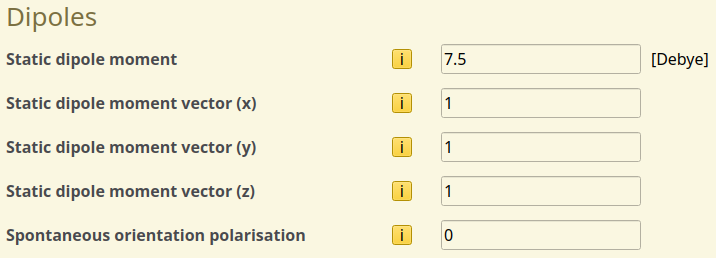
Fig. 135 Material dipole parameters
Because dipolar interactions fall off naturally at the layer interfaces, the inclusion of a spatial energy correlation to the dipole field allows modeling of giant surface potential (GSP) effects on device operation. This effect is further augmented by intrinsic SOP of the materials.
Note
Variations in the transition dipole moment affect intermolecular exciton transfer processes, and can be specified by including the transition dipole moment distribution in the Materials page. This process is analogous to the above description of the molecular dipole distribution.
To include orientational variance in the transition dipole moment during excitonic simulations, the Parameters → Advanced → Include Orientational Disorder option can be enabled.