
General
Introduction
Bumblebee utilizes kinetic Monte Carlo simulations to model the opto-electronic properties of OLED stacks. The transport of the electrons through the device is described stochastically in order to determine the time-evolution and space-dependence of excitonic processes.
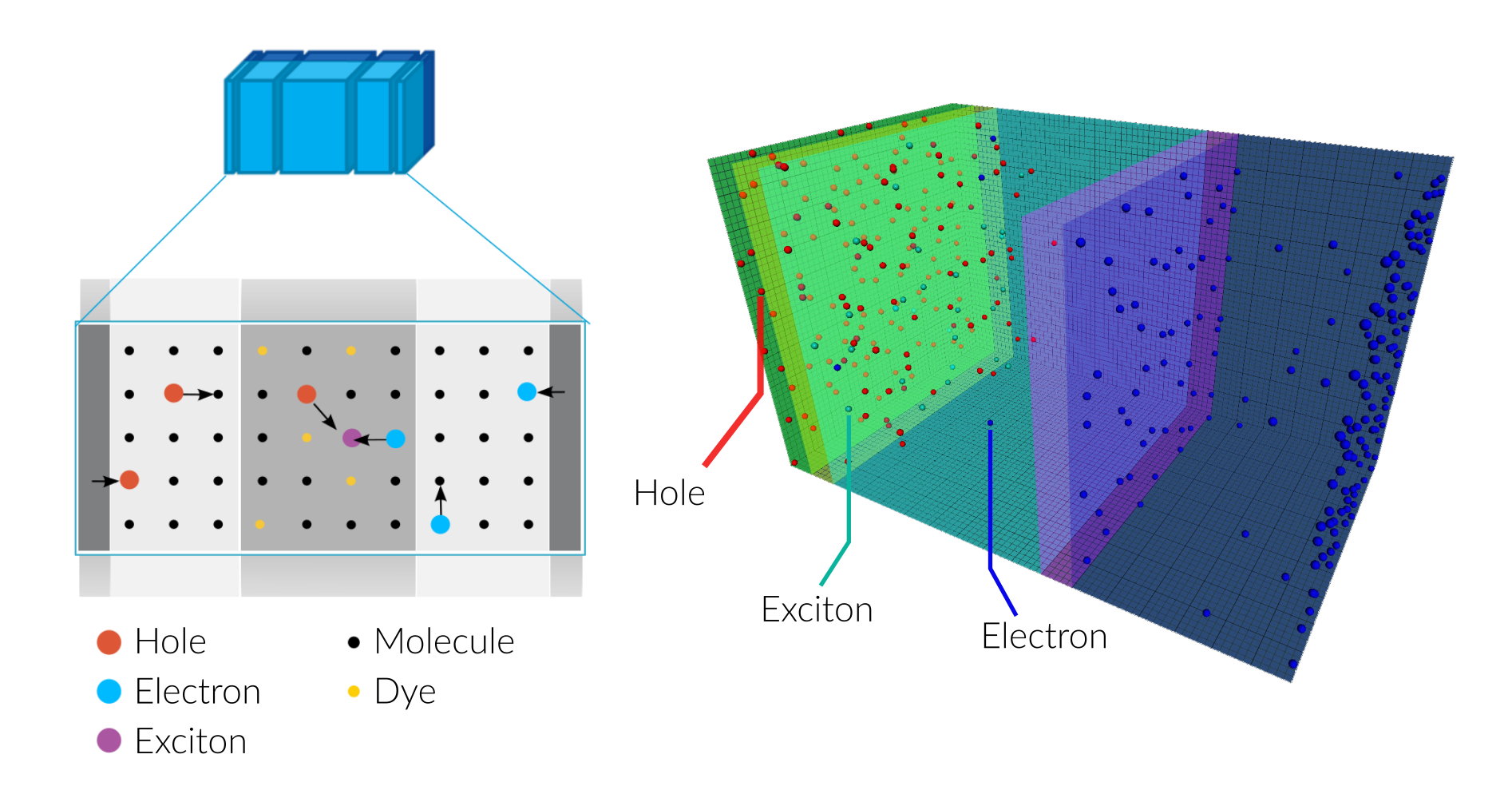
Input parameters for the OLED materials can be obtained using:
The built-in materials database
The AMS OLED Workflow
Quantum-chemical simulations with ADF
Experimental data
Features
Bumblebee is capable of simulating OLED stacks containing numerous layers comprised of both pure and composite materials.
An extensive array of excitonic interactions can be included to describe the opto-electronic character
Device degradation can be modeled to estimate stack lifetimes
Photoluminescent absorption allows replication of TRPL, dark-field and PV studies
Optical outcoupling simulations predict emission spectra at the device level
Perform small-signal analysis with AC modulation
Applications
Bumblebee is used for the modeling of organic electronics. The module focuses on describing charge transport through the device, as well as the conversion between current and light. Various device architectures are supported:
Organic light-emitting diodes (OLED)
Organic field-effect transistors (OFET)
Organic photovoltaics (OPV)
Organic photodetectors (OPD)
Organic lasers (OLx)
See the Tutorials for more detailed application examples.
Version History
New in AMS2026
Starting with AMS2026, Bumblebee has been fully integrated with the other modules and no longer requires a separate installation. The new BBinput and BBresults menus in the AMS GUI can be used for setting up new simulations and analyzing the output data.
Note
Bumblebee 2026 can be installed on Windows, MacOS and Linux systems. Both local and remote simulations are supported through the AMS GUI.
New features provided with Bumblebee 2026:
Decay-stimulated degradation processes
Thermal device degradation
Capacitance measurements
Contact defects
Transient potential distributions for OPV devices
Optical outcoupling for self-absorbing materials
General performance improvements
New in AMS2025
Exciplexes and CT states
Charge generation layers
Support for QLED and QNED
Thermally-activated ISC/RISC
Quadrupolar interactions
Transient signal module, enabling e.g. custom voltage signals or pulsed illumination experiments
Spontaneous orientation polarization (SOP) and giant surface potential (GSP) effects