
Binary Ionic Liquid Mixtures for CO2 Absorption
Ionic liquids have been investigated extensively for CO2 absorption on account of their unusually high selectivity compared to traditional absorbents. Binary ionic liquid mixtures provide an appealing route for process-tunable CO2 selectivity without requiring the design of new synthesis pathways. In this example, we will show how the COSMO-RS-IL method can be used to predict the separation efficiency of these binary ionic liquid mixtures, facilitating fast computational pre-screening and optimization.
Blending the Ionic Liquids
For this example, we will look at a blend of [OMIM][BF4] and [OMIM][Tf2N]. The individual ions are included in the CRS database.
OMIM in the search bar. Select the compound from the list and click the OK button to add it to the workspace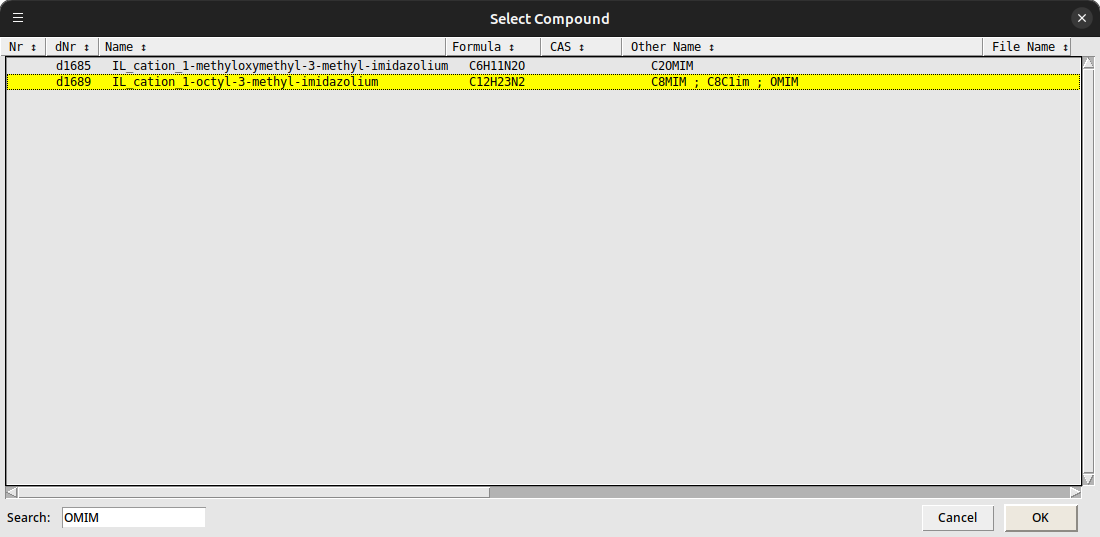
Once the ions have been added to the workspace, we can make the ionic liquids.
IL_cation_1-octyl-3-methyl-imidazolium and IL_anion_tetrafluoroborate as compounds by using the dropdown menus. This will define a dissociated cation-anion pairOMIM_BF4 and choose SaveIL_anion_bis(trifluoromethylsulfonyl)amideOMIM_Tf2N and choose Save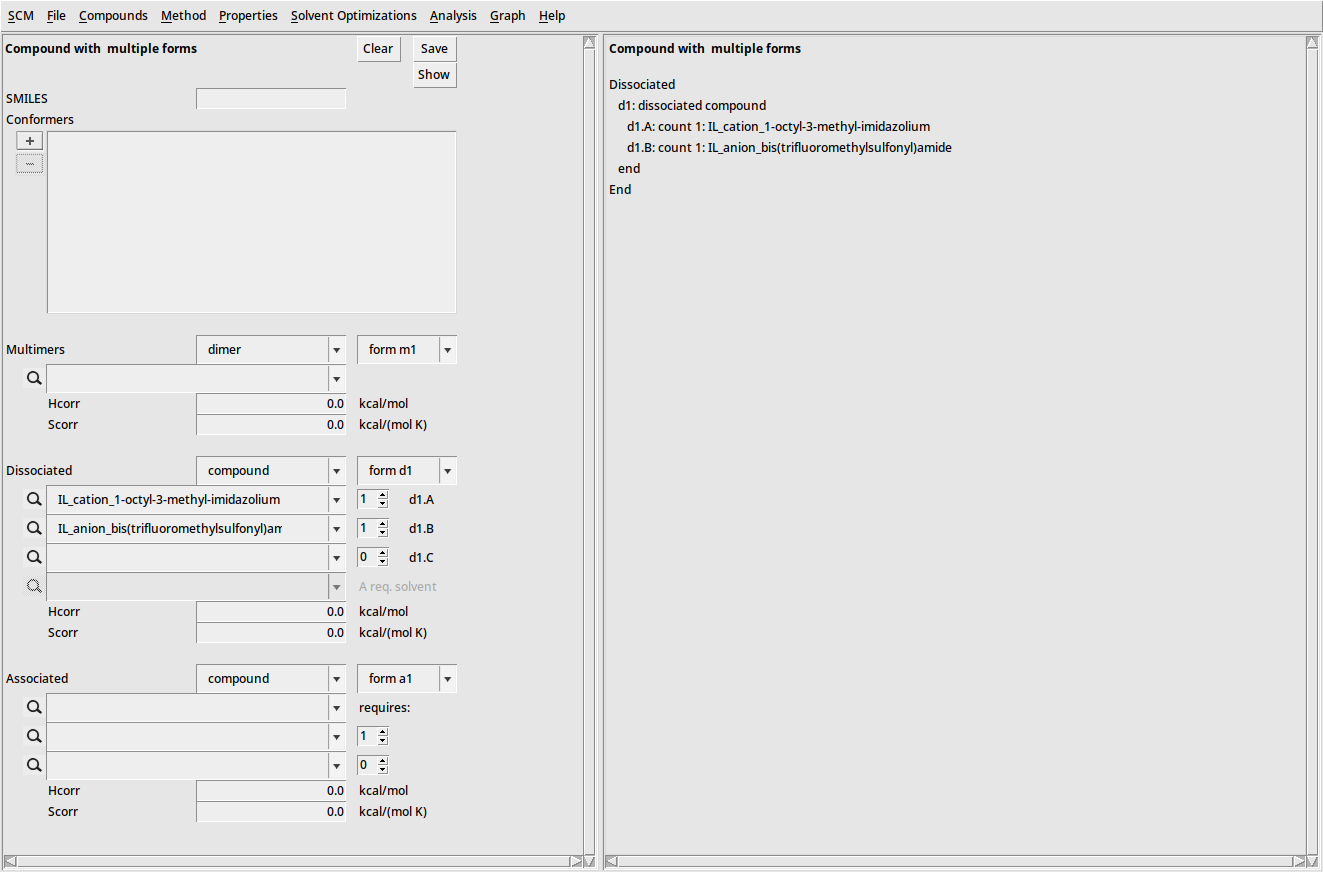
Both ionic liquids will now be available as compounds in the AMScrs workspace. This allows us to select them in the property calculations.
Note
When predicting properties for ionic liquids that are not included in the database, you will need to first run a compound calculation in order to obtain the required COSMO-RS parameters. Check out the COSMO-RS tutorials to learn more.
Calculating CO2 Solubility
AMScrs supports calculating the solubility in mixed solvents. In order to calculate the solubility of CO2, we first add it as a compound from the database.
CO2 in the search bar. Select the compound from the list and click the OK button to add it to the workspaceWe can now define an ionic liquid mixture in order to generate the solubility data. The low-temperature, medium-pressure regime will be considered here, in order to compare with experimental reference data.
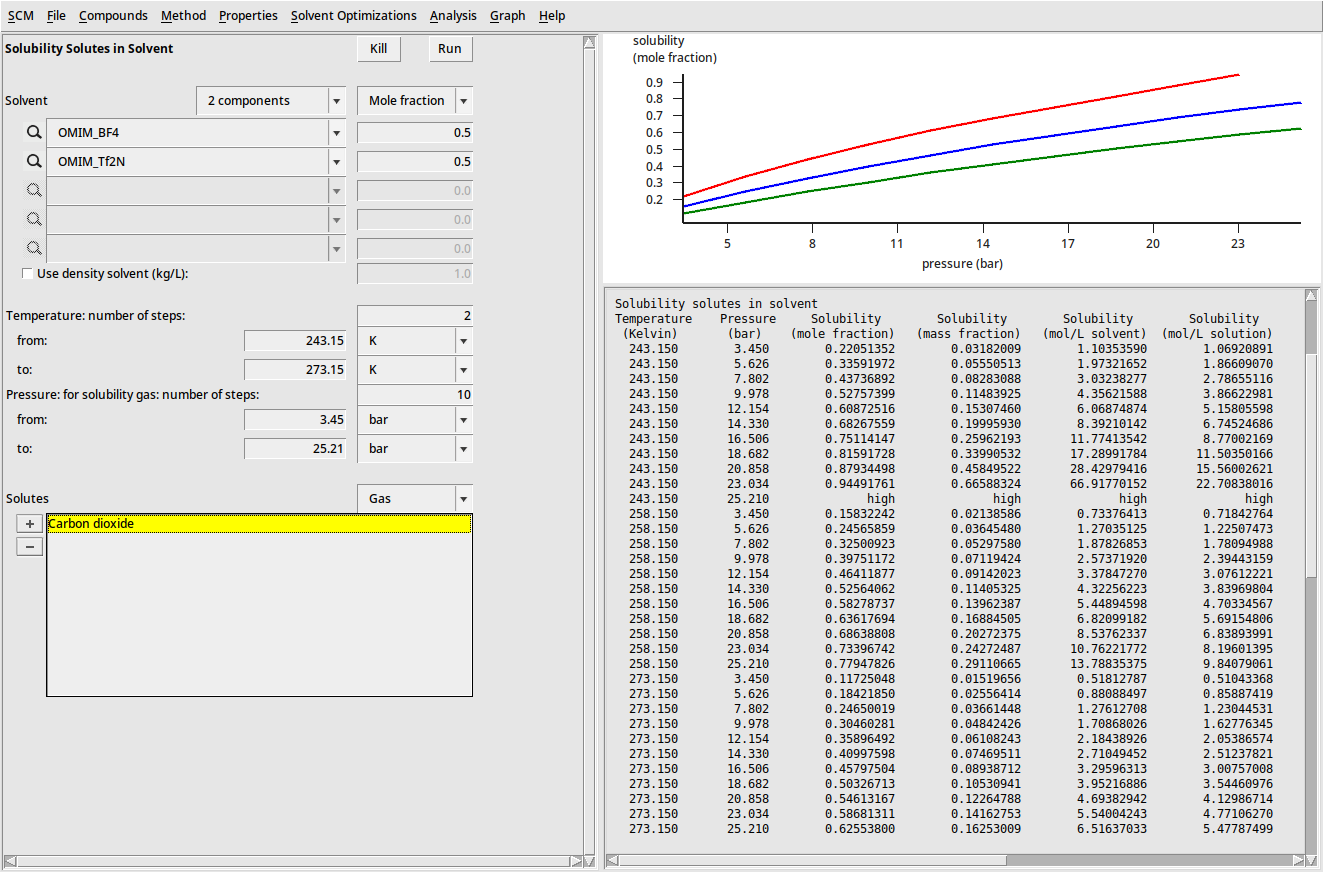
OMIM_BF4 and OMIM_Tf2N as the solvent compounds by using the dropdown menus button to bring up the list of compounds. Select
Carbon dioxide from the list and click AddBoth a graph and table containing the calculated solubility data will be generated.
Compressibility Factor
A comparison with experimental solubility data is given in the figure below. A slight underestimation of the predicted CO2 solubility is noted, although the general trends and slope of the solubility curves are reproduced quite well. Increased deviations at lower temperatures / higher pressures suggest that compressibility may be responsible.
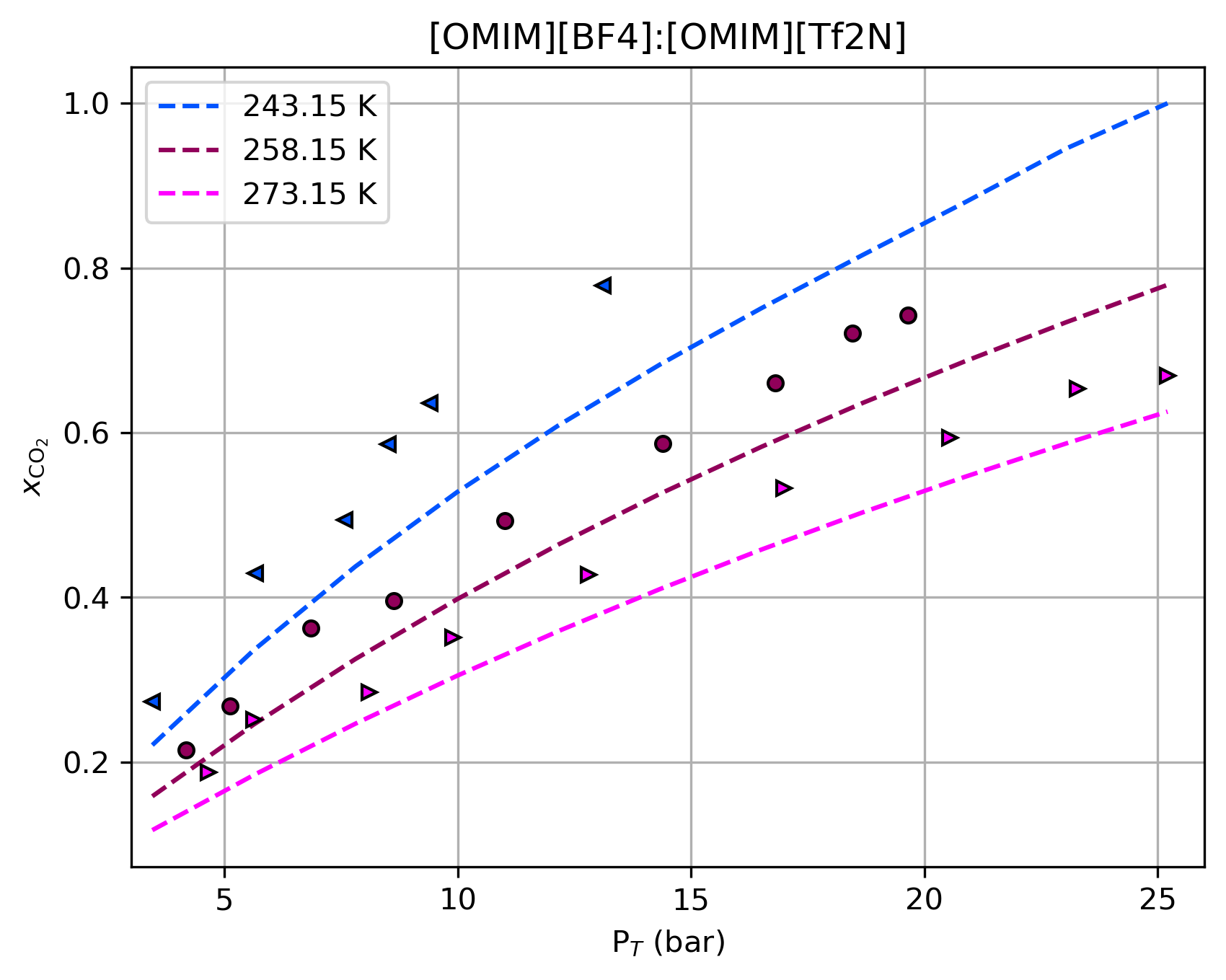
Fig. 77 Comparison between experimental solubilities[1] and predicted values obtained from COSMO-RS for an ideal gas
AMScrs calculations assume ideal gas behavior by default. We can account for non-ideal compressibility by using experimental fugacity data.[2] (Where fugacity coefficients depend on both temperature and pressure.) After this correction, results are seen to align closer with experiment.
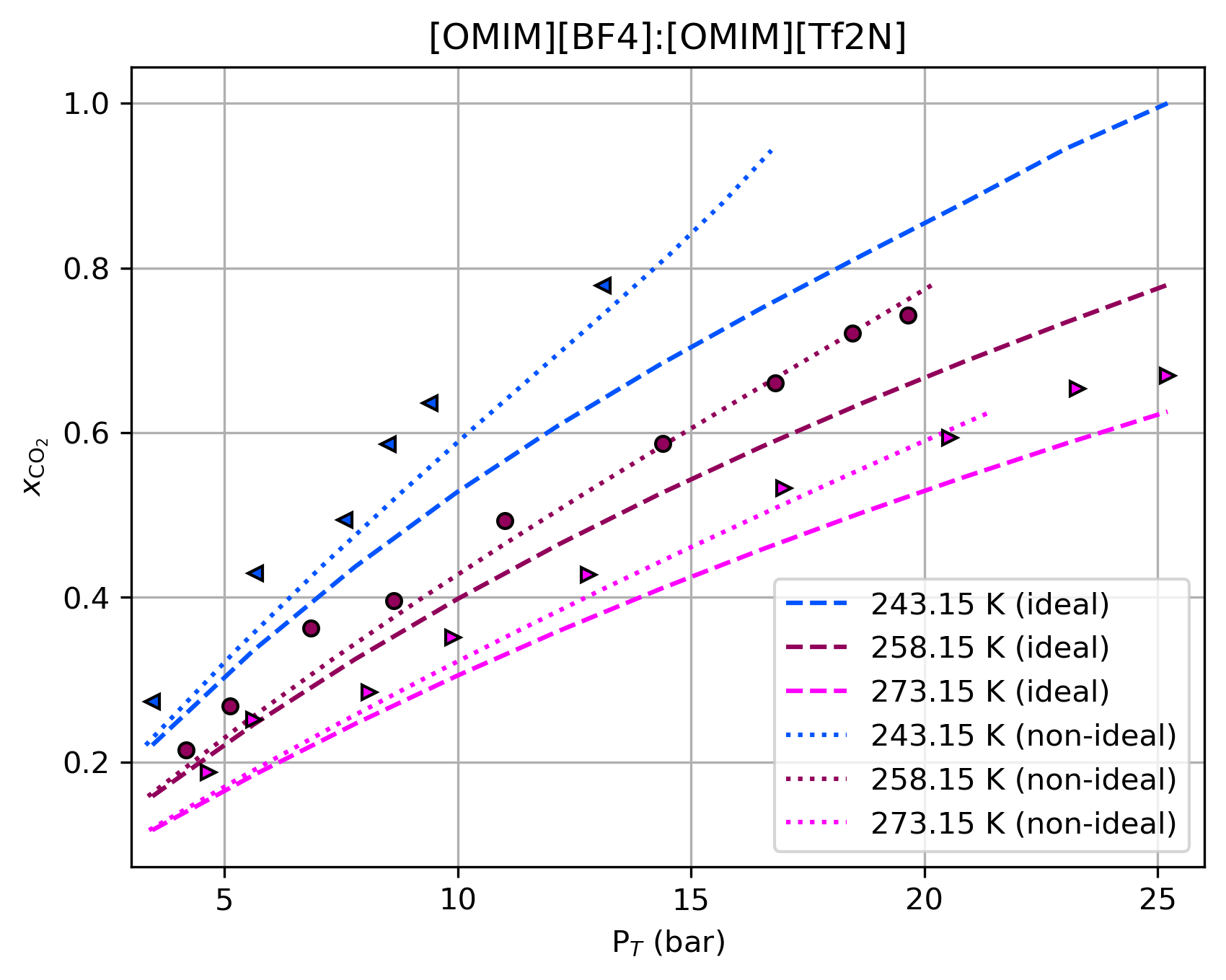
Fig. 78 Comparison between experimental solubilities[1] and predicted values obtained from COSMO-RS accounting for non-ideal compressibility[2]
For this example, we have focused on reproducing solubility data for a prescribed mixture. The fast calculations offered by COSMO-RS also allow us to easily evaluate other blend ratios or mixtures of different ionic liquids in order to pre-optimize high-solubility absorbents.
Tip
Automated workflows can help speed up large-scale screenings:
An example is available for the automated screening of ionic liquids
Check out the PyCRS page for more info on setting up custom workflows