
Building Packed Systems with Packmol
This example illustrates several ways of building liquid or gas mixtures and solid-liquid interfaces from Python with Packmol-driven structure generation.
Note
The packmol functions returns a PLAMS Molecule, that can be converted to a ChemicalSystem.
Initial imports
from scm.plams import plot_molecule, from_smiles, Molecule, packmol, packmol_around, view
from ase.visualize.plot import plot_atoms
from ase.build import fcc111, bulk
import matplotlib.pyplot as plt
Helper functions
def printsummary(mol, details=None):
    if details:
        density = details["density"]
    else:
        density = mol.get_density() * 1e-3
    s = f"{len(mol)} atoms, density = {density:.3f} g/cm^3"
    if mol.lattice:
        s += f", box = {mol.lattice[0][0]:.3f}, {mol.lattice[1][1]:.3f}, {mol.lattice[2][2]:.3f}"
    s += f", formula = {mol.get_formula()}"
    if details:
        s += f"\n#added molecules per species: {details['n_molecules']}, mole fractions: {details['mole_fractions']}"
    print(s)
Liquid water (fluid with 1 component)
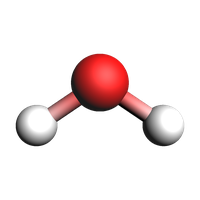
First, create the gasphase molecule:
water = from_smiles("O")
view(water, width=200, height=200)
print(
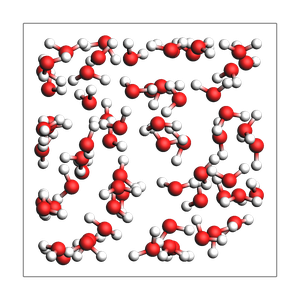
    "pure liquid from approximate number of atoms and exact density (in g/cm^3), cubic box with auto-determined size"
)
out = packmol(water, n_atoms=194, density=1.0)
printsummary(out)
out.write("water-1.xyz")
view(out, width=300, height=300, padding=-2)
pure liquid from approximate number of atoms and exact density (in g/cm^3), cubic box with auto-determined size
195 atoms, density = 1.000 g/cm^3, box = 12.482, 12.482, 12.482, formula = H130O65
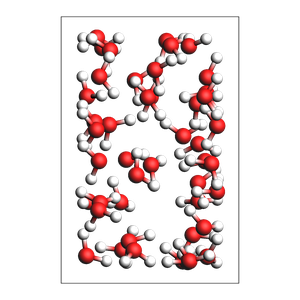
print("pure liquid from approximate density (in g/cm^3) and an orthorhombic box")
out = packmol(water, density=1.0, box_bounds=[0.0, 0.0, 0.0, 8.0, 12.0, 14.0])
printsummary(out)
out.write("water-2.xyz")
view(out, width=300, height=300, padding=-2)
pure liquid from approximate density (in g/cm^3) and an orthorhombic box
135 atoms, density = 1.002 g/cm^3, box = 8.000, 12.000, 14.000, formula = H90O45
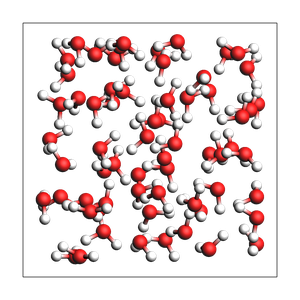
print("pure liquid with explicit number of molecules and exact density")
out = packmol(water, n_molecules=64, density=1.0)
printsummary(out)
out.write("water-3.xyz")
view(out, width=300, height=300, padding=-2)
pure liquid with explicit number of molecules and exact density
192 atoms, density = 1.000 g/cm^3, box = 12.417, 12.417, 12.417, formula = H128O64
print("pure liquid with explicit number of molecules and box")
out = packmol(water, n_molecules=64, box_bounds=[0.0, 0.0, 0.0, 12.0, 13.0, 14.0])
printsummary(out)
out.write("water-4.xyz")
view(out, width=300, height=300, padding=-2)
pure liquid with explicit number of molecules and box
192 atoms, density = 0.877 g/cm^3, box = 12.000, 13.000, 14.000, formula = H128O64
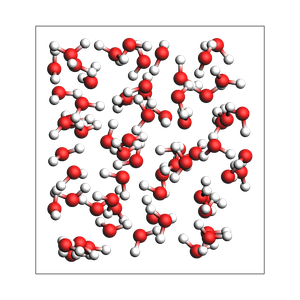
print("water-5.xyz: pure liquid in non-orthorhombic box (requires AMS2025 or later)")
print(
    "NOTE: Non-orthorhombic boxes may yield inaccurate results, always carefully check the output"
)
# You can pack inside any lattice using the packmol_around function
box = Molecule()
box.lattice = [[10.0, 2.0, -1.0], [-5.0, 8.0, 0.0], [0.0, -2.0, 11.0]]
out = packmol_around(box, molecules=[water], n_molecules=[32])
out.write("water-5.xyz")
view(out, width=300, height=300, padding=-2)
water-5.xyz: pure liquid in non-orthorhombic box (requires AMS2025 or later)
NOTE: Non-orthorhombic boxes may yield inaccurate results, always carefully check the output


Note: The following floating-point exceptions are signalling: IEEE_INVALID_FLAG IEEE_DIVIDE_BY_ZERO
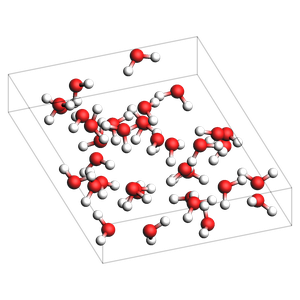
print("Experimental feature (AMS2025): guess density for pure liquid")
print("Note: This density is meant to be equilibrated with NPT MD. It can be very inaccurate!")
out = packmol(water, n_atoms=100)
print(f"Guessed density: {out.get_density():.2f} kg/m^3")
view(out, width=200, height=200, padding=-2)
Experimental feature (AMS2025): guess density for pure liquid
Note: This density is meant to be equilibrated with NPT MD. It can be very inaccurate!
Guessed density: 1013.97 kg/m^3
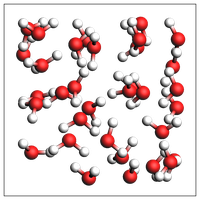
Water-acetonitrile mixture (fluid with 2 or more components)
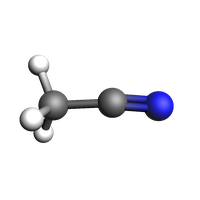
Let’s also create a single acetonitrile molecule:
acetonitrile = from_smiles("CC#N")
view(acetonitrile, width=200, height=200)
Set the desired mole fractions and density. Here, the density is calculated as the weighted average of water (1.0 g/cm^3) and acetonitrile (0.76 g/cm^3) densities, but you could use any other density.
# MIXTURES
x_water = 0.666  # mole fraction
x_acetonitrile = 1 - x_water  # mole fraction
# weighted average of pure component densities
density = (x_water * 1.0 + x_acetonitrile * 0.76) / (x_water + x_acetonitrile)

print("MIXTURES")
print(f"x_water = {x_water:.3f}")
print(f"x_acetonitrile = {x_acetonitrile:.3f}")
print(f"target density = {density:.3f} g/cm^3")
MIXTURES
x_water = 0.666
x_acetonitrile = 0.334
target density = 0.920 g/cm^3
By setting return_details=True, you can get information about the mole fractions of the returned system. They may not exactly match the mole fractions you put in.
print(
    "2-1 water-acetonitrile from approximate number of atoms and exact density (in g/cm^3), "
    "cubic box with auto-determined size"
)
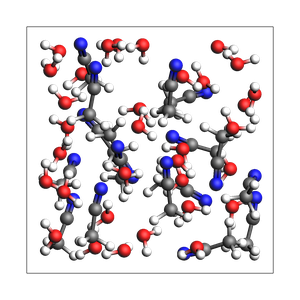
out, details = packmol(
    molecules=[water, acetonitrile],
    mole_fractions=[x_water, x_acetonitrile],
    n_atoms=200,
    density=density,
    return_details=True,
)
printsummary(out, details)
out.write("water-acetonitrile-1.xyz")
view(out, width=300, height=300, padding=-2)
2-1 water-acetonitrile from approximate number of atoms and exact density (in g/cm^3), cubic box with auto-determined size
201 atoms, density = 0.920 g/cm^3, box = 13.263, 13.263, 13.263, formula = C34H117N17O33
#added molecules per species: [33, 17], mole fractions: [0.66, 0.34]
The details is a dictionary as follows:
for k, v in details.items():
    print(f"{k}: {v}")
n_molecules: [33, 17]
mole_fractions: [0.66, 0.34]
n_atoms: 201
molecule_type_indices: [0, 0, 0, 0, 0, 0, 0, 0, 0, 0, 0, 0, 0, 0, 0, 0, 0, 0, 0, 0, 0, 0, 0, 0, 0, 0, 0, 0, 0, 0, 0, 0, 0, 0, 0, 0, 0, 0, 0, 0, 0, 0, 0, 0, 0, 0, 0, 0, 0, 0, 0, 0, 0, 0, 0, 0, 0, 0, 0, 0, 0, 0, 0, 0, 0, 0, 0, 0, 0, 0, 0, 0, 0, 0, 0, 0, 0, 0, 0, 0, 0, 0, 0, 0, 0, 0, 0, 0, 0, 0, 0, 0, 0, 0, 0, 0, 0, 0, 0, 1, 1, 1, 1, 1, 1, 1, 1, 1, 1, 1, 1, 1, 1, 1, 1, 1, 1, 1, 1, 1, 1, 1, 1, 1, 1, 1, 1, 1, 1, 1, 1, 1, 1, 1, 1, 1, 1, 1, 1, 1, 1, 1, 1, 1, 1, 1, 1, 1, 1, 1, 1, 1, 1, 1, 1, 1, 1, 1, 1, 1, 1, 1, 1, 1, 1, 1, 1, 1, 1, 1, 1, 1, 1, 1, 1, 1, 1, 1, 1, 1, 1, 1, 1, 1, 1, 1, 1, 1, 1, 1, 1, 1, 1, 1, 1, 1, 1, 1, 1, 1, 1]
molecule_indices: [0, 0, 0, 1, 1, 1, 2, 2, 2, 3, 3, 3, 4, 4, 4, 5, 5, 5, 6, 6, 6, 7, 7, 7, 8, 8, 8, 9, 9, 9, 10, 10, 10, 11, 11, 11, 12, 12, 12, 13, 13, 13, 14, 14, 14, 15, 15, 15, 16, 16, 16, 17, 17, 17, 18, 18, 18, 19, 19, 19, 20, 20, 20, 21, 21, 21, 22, 22, 22, 23, 23, 23, 24, 24, 24, 25, 25, 25, 26, 26, 26, 27, 27, 27, 28, 28, 28, 29, 29, 29, 30, 30, 30, 31, 31, 31, 32, 32, 32, 33, 33, 33, 33, 33, 33, 34, 34, 34, 34, 34, 34, 35, 35, 35, 35, 35, 35, 36, 36, 36, 36, 36, 36, 37, 37, 37, 37, 37, 37, 38, 38, 38, 38, 38, 38, 39, 39, 39, 39, 39, 39, 40, 40, 40, 40, 40, 40, 41, 41, 41, 41, 41, 41, 42, 42, 42, 42, 42, 42, 43, 43, 43, 43, 43, 43, 44, 44, 44, 44, 44, 44, 45, 45, 45, 45, 45, 45, 46, 46, 46, 46, 46, 46, 47, 47, 47, 47, 47, 47, 48, 48, 48, 48, 48, 48, 49, 49, 49, 49, 49, 49]
atom_indices_in_molecule: [0, 1, 2, 0, 1, 2, 0, 1, 2, 0, 1, 2, 0, 1, 2, 0, 1, 2, 0, 1, 2, 0, 1, 2, 0, 1, 2, 0, 1, 2, 0, 1, 2, 0, 1, 2, 0, 1, 2, 0, 1, 2, 0, 1, 2, 0, 1, 2, 0, 1, 2, 0, 1, 2, 0, 1, 2, 0, 1, 2, 0, 1, 2, 0, 1, 2, 0, 1, 2, 0, 1, 2, 0, 1, 2, 0, 1, 2, 0, 1, 2, 0, 1, 2, 0, 1, 2, 0, 1, 2, 0, 1, 2, 0, 1, 2, 0, 1, 2, 0, 1, 2, 3, 4, 5, 0, 1, 2, 3, 4, 5, 0, 1, 2, 3, 4, 5, 0, 1, 2, 3, 4, 5, 0, 1, 2, 3, 4, 5, 0, 1, 2, 3, 4, 5, 0, 1, 2, 3, 4, 5, 0, 1, 2, 3, 4, 5, 0, 1, 2, 3, 4, 5, 0, 1, 2, 3, 4, 5, 0, 1, 2, 3, 4, 5, 0, 1, 2, 3, 4, 5, 0, 1, 2, 3, 4, 5, 0, 1, 2, 3, 4, 5, 0, 1, 2, 3, 4, 5, 0, 1, 2, 3, 4, 5, 0, 1, 2, 3, 4, 5]
volume: 2333.0853879652004
density: 0.9198400000000004
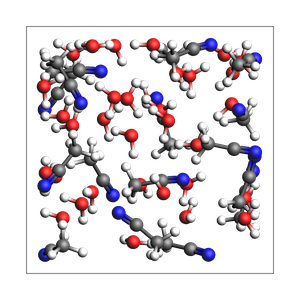
print("2-1 water-acetonitrile from approximate density (in g/cm^3) and box bounds")
out, details = packmol(
    molecules=[water, acetonitrile],
    mole_fractions=[x_water, x_acetonitrile],
    box_bounds=[0, 0, 0, 13.2, 13.2, 13.2],
    density=density,
    return_details=True,
)
printsummary(out, details)
out.write("water-acetonitrile-2.xyz")
view(out, width=300, height=300, padding=-2)
2-1 water-acetonitrile from approximate density (in g/cm^3) and box bounds
201 atoms, density = 0.933 g/cm^3, box = 13.200, 13.200, 13.200, formula = C34H117N17O33
#added molecules per species: [33, 17], mole fractions: [0.66, 0.34]
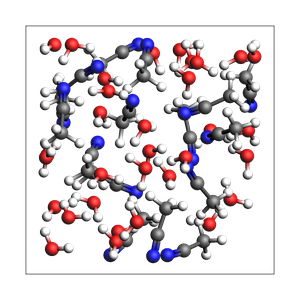
print(
    "2-1 water-acetonitrile from explicit number of molecules and density, cubic box with auto-determined size"
)
out, details = packmol(
    molecules=[water, acetonitrile],
    n_molecules=[32, 16],
    density=density,
    return_details=True,
)
printsummary(out, details)
out.write("water-acetonitrile-3.xyz")
view(out, width=300, height=300, padding=-2)
2-1 water-acetonitrile from explicit number of molecules and density, cubic box with auto-determined size
192 atoms, density = 0.920 g/cm^3, box = 13.058, 13.058, 13.058, formula = C32H112N16O32
#added molecules per species: [32, 16], mole fractions: [0.6666666666666666, 0.3333333333333333]
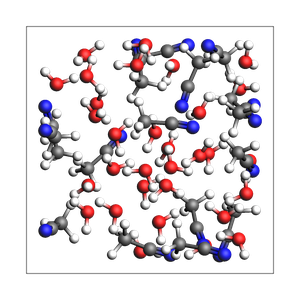
print("2-1 water-acetonitrile from explicit number of molecules and box")
out = packmol(
    molecules=[water, acetonitrile],
    n_molecules=[32, 16],
    box_bounds=[0, 0, 0, 13.2, 13.2, 13.2],
)
printsummary(out)
out.write("water-acetonitrile-4.xyz")
view(out, width=300, height=300, padding=-2)
2-1 water-acetonitrile from explicit number of molecules and box
192 atoms, density = 0.890 g/cm^3, box = 13.200, 13.200, 13.200, formula = C32H112N16O32
print("Experimental feature (AMS2025): guess density for mixture")
print("Note: This density is meant to be equilibrated with NPT MD. It can be very inaccurate!")
out = packmol([water, acetonitrile], mole_fractions=[x_water, x_acetonitrile], n_atoms=100)
print(f"Guessed density: {out.get_density():.2f} kg/m^3")
view(out, width=200, height=200, padding=-2)
Experimental feature (AMS2025): guess density for mixture
Note: This density is meant to be equilibrated with NPT MD. It can be very inaccurate!
Guessed density: 849.35 kg/m^3
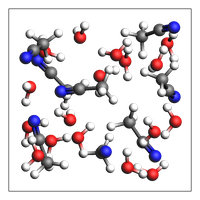
NaCl solution (solvent with 1 or more solutes)
sodium = from_smiles("[Na+]")
chloride = from_smiles("[Cl-]")
For dilute solutions, it can be useful to specify the number of solute species, and fill up the rest of the box with solvent.
The required number of solvent molecules are then added to fill up the box to the target overall density or number of atoms.
This feature can be used if exactly one of the elements of the n_molecules list is None.
print(
    "NaCl solution from approximate density (in g/cm^3) and box bounds, and auto-determined number of solvent molecules"
)
out = packmol(
    [sodium, chloride, water],
    n_molecules=[5, 5, None],
    density=1.029,
    box_bounds=[0, 0, 0, 19, 19, 19],
)
printsummary(out)
out.write("sodium-chloride-solution-1.xyz")
view(out, width=300, height=300, padding=-3, fixed_atom_size=False)
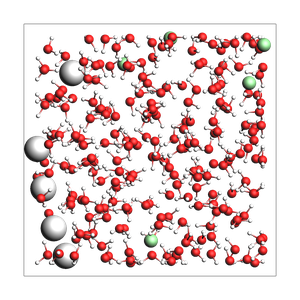
NaCl solution from approximate density (in g/cm^3) and box bounds, and auto-determined number of solvent molecules
670 atoms, density = 1.030 g/cm^3, box = 19.000, 19.000, 19.000, formula = Cl5H440Na5O220
Specify the total number of atoms instead of box bounds, and auto-determine a cubic box:
print("NaCl solution from approximate number of atoms and density:")
out = packmol([sodium, chloride, water], n_molecules=[5, 5, None], density=1.029, n_atoms=500)
printsummary(out)
out.write("sodium-chloride-solution-2.xyz")
view(out, width=300, height=300, padding=-3, fixed_atom_size=False)
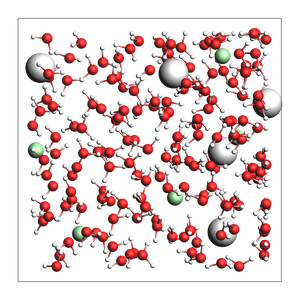
NaCl solution from approximate number of atoms and density:
499 atoms, density = 1.029 g/cm^3, box = 17.336, 17.336, 17.336, formula = Cl5H326Na5O163
Specify the total number of atoms instead of the density (less useful option):
print("NaCl solution from approximate number of atoms and box_bounds:")
out = packmol(
    [sodium, chloride, water],
    n_molecules=[5, 5, None],
    n_atoms=500,
    box_bounds=[0, 0, 0, 12, 18, 24],
)
printsummary(out)
out.write("sodium-chloride-solution-3.xyz")
view(out, width=300, height=300, padding=-3, fixed_atom_size=False)
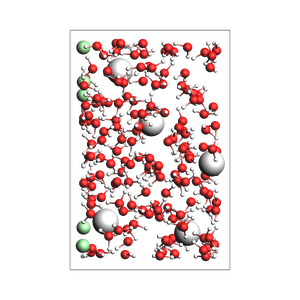
NaCl solution from approximate number of atoms and box_bounds:
499 atoms, density = 1.034 g/cm^3, box = 12.000, 18.000, 24.000, formula = Cl5H326Na5O163
Pack inside sphere
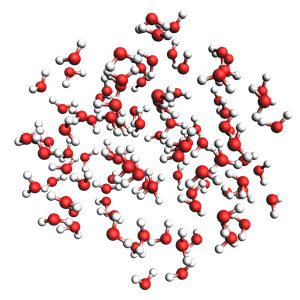
Set sphere=True to pack in a sphere (non-periodic) instead of in a periodic box. The sphere will be centered near the origin.
print("water in a sphere from exact density and number of molecules")
out, details = packmol(
    molecules=[water], n_molecules=[100], density=1.0, return_details=True, sphere=True
)
printsummary(out, details)
print(f"Radius  of sphere: {details['radius']:.3f} ang.")
print(f"Center of mass xyz (ang): {out.get_center_of_mass()}")
out.write("water-sphere.xyz")
view(out, width=300, height=300, padding=-3)
water in a sphere from exact density and number of molecules
300 atoms, density = 1.000 g/cm^3, formula = H200O100
#added molecules per species: [100], mole fractions: [1.0]
Radius  of sphere: 8.939 ang.
Center of mass xyz (ang): (0.20524516063289328, -0.5488418178082475, 0.23787221518750662)
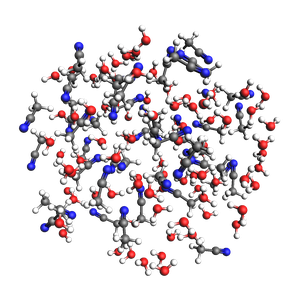
print(
    "2-1 water-acetonitrile in a sphere from exact density (in g/cm^3) and "
    "approximate number of atoms and mole fractions"
)
out, details = packmol(
    molecules=[water, acetonitrile],
    mole_fractions=[x_water, x_acetonitrile],
    n_atoms=500,
    density=density,
    return_details=True,
    sphere=True,
)
printsummary(out, details)
out.write("water-acetonitrile-sphere.xyz")
view(out, width=300, height=300, padding=-3)
2-1 water-acetonitrile in a sphere from exact density (in g/cm^3) and approximate number of atoms and mole fractions
501 atoms, density = 0.920 g/cm^3, formula = C84H292N42O83
#added molecules per species: [83, 42], mole fractions: [0.664, 0.336]
Packing ions, total system charge
The total system charge will be sum of the charges of the constituent molecules.
In PLAMS, molecule.properties.charge specifies the charge:
ammonium = from_smiles("[NH4+]")  # ammonia.properties.charge == +1
chloride = from_smiles("[Cl-]")  # chloride.properties.charge == -1
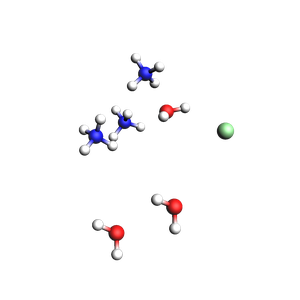
print("3 water molecules, 3 ammonium, 1 chloride (non-periodic)")
print("Initial charges:")
print(f"Water: {water.properties.get('charge', 0)}")
print(f"Ammonium: {ammonium.properties.get('charge', 0)}")
print(f"Chloride: {chloride.properties.get('charge', 0)}")
out = packmol(
    molecules=[water, ammonium, chloride], n_molecules=[3, 3, 1], density=0.4, sphere=True
)
tot_charge = out.properties.get("charge", 0)
print(f"Total charge of packmol-generated system: {tot_charge}")
out.write("water-ammonium-chloride.xyz")
view(out, width=300, height=300)
3 water molecules, 3 ammonium, 1 chloride (non-periodic)
Initial charges:
Water: 0
Ammonium: 1
Chloride: -1
Total charge of packmol-generated system: 2
Microsolvation
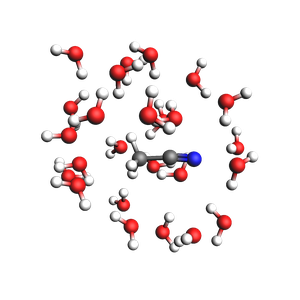
packmol_microsolvation can create a microsolvation sphere around a solute.
from scm.plams import packmol_microsolvation

out = packmol_microsolvation(solute=acetonitrile, solvent=water, density=1.5, threshold=4.0)
# for microsolvation it's a good idea to have a higher density than normal to get enough solvent molecules
print(f"Microsolvated structure: {len(out)} atoms.")
out.write("acetonitrile-microsolvated.xyz")

view(out, width=300, height=300, padding=-1)
Microsolvated structure: 69 atoms.
Solid-liquid or solid-gas interfaces
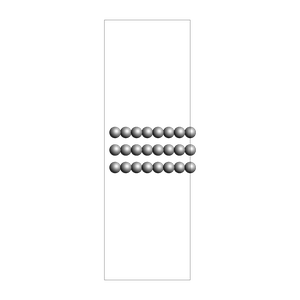
First, create a slab using the ASE fcc111 function
from scm.plams import plot_molecule, fromASE
from ase.build import fcc111

rotation = "90x,0y,0z"  # sideview of slab
slab = fromASE(fcc111("Al", size=(4, 6, 3), vacuum=15.0, orthogonal=True, periodic=True))
view(slab, width=300, height=300, direction="along_y", fixed_atom_size=False)
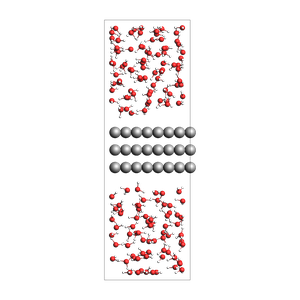
print("water surrounding an Al slab, from an approximate density")
out = packmol_around(slab, water, density=1.0)
printsummary(out)
out.write("al-water-pure.xyz")
view(out, width=300, height=300, direction="along_y", fixed_atom_size=False)
water surrounding an Al slab, from an approximate density
534 atoms, density = 1.325 g/cm^3, box = 11.455, 14.881, 34.677, formula = Al72H308O154
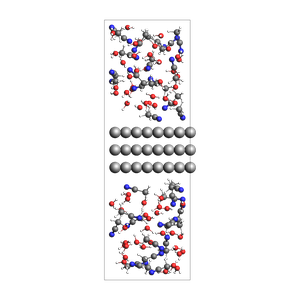
print(
    "2-1 water-acetonitrile mixture surrounding an Al slab, from mole fractions and an approximate density"
)
out = packmol_around(
    slab, [water, acetonitrile], mole_fractions=[x_water, x_acetonitrile], density=density
)
printsummary(out)
out.write("al-water-acetonitrile.xyz")
view(out, width=300, height=300, direction="along_y", fixed_atom_size=False)
2-1 water-acetonitrile mixture surrounding an Al slab, from mole fractions and an approximate density
468 atoms, density = 1.260 g/cm^3, box = 11.455, 14.881, 34.677, formula = C66H231Al72N33O66
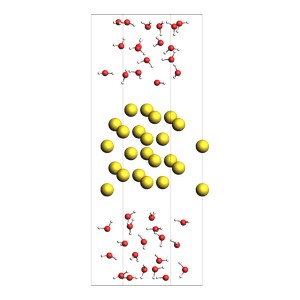
from ase.build import surface

print(
    "water surrounding non-orthorhombic Au(211) slab, from an approximate number of molecules"
)
print("NOTE: non-orthorhombic cell, results are approximate, requires AMS2025")
slab = surface("Au", (2, 1, 1), 6)
slab.center(vacuum=11.0, axis=2)
slab.set_pbc(True)
out = packmol_around(fromASE(slab), [water], n_molecules=[32], tolerance=1.8)
out.write("Au211-water.xyz")
print(f"{out.lattice=}")
view(out, width=300, height=300, direction="along_y", fixed_atom_size=False)
water surrounding non-orthorhombic Au(211) slab, from an approximate number of molecules
NOTE: non-orthorhombic cell, results are approximate, requires AMS2025
out.lattice=[[9.1231573482, 0.0, 0.0], [3.6492629392999993, 4.4694160692, 0.0], [0.0, 0.0, 31.161091638]]
Pack inside voids in crystals
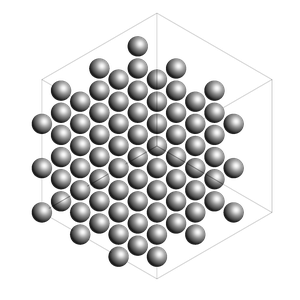
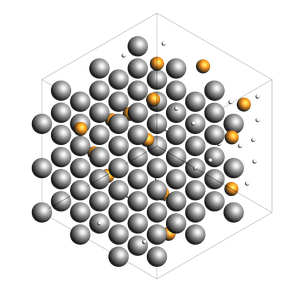
Use the packmol_around function. You can decrease tolerance if you need to pack very tightly. The default value for tolerance is 2.0.
from scm.plams import fromASE
from ase.build import bulk

bulk_Al = fromASE(bulk("Al", cubic=True).repeat((3, 3, 3)))
rotation = "-85x,5y,0z"
view(bulk_Al, width=300, height=300, direction="corner_z", fixed_atom_size=False)
out = packmol_around(
    current=bulk_Al,
    molecules=[from_smiles("[H]"), from_smiles("[He]")],
    n_molecules=[50, 20],
    tolerance=1.5,
)
printsummary(out)
out.write("al-bulk-with-h-he.xyz")
view(out, width=300, height=300, direction="corner_z", fixed_atom_size=False)
[17:27:42] UFFTYPER: Unrecognized atom type: He1 (0)


178 atoms, density = 2.819 g/cm^3, box = 12.150, 12.150, 12.150, formula = Al108H50He20
Bonds, atom properties (force field types, regions, …)
The packmol() function accepts the arguments keep_bonds and keep_atom_properties. These options will keep the bonds defined for the constitutent molecules, as well as any atomic properties.
The bonds and atom properties are easiest to see by printing the System block for an AMS job:
from scm.plams import Settings

water = from_smiles("O")
n2 = from_smiles("N#N")

# delete properties coming from from_smiles
for at in water:
    at.properties = Settings()
for at in n2:
    at.properties = Settings()

water[1].properties.region = "oxygen_atom"
water[2].properties.mass = 2.014  # deuterium
water.delete_bond(water[1, 2])  # delete bond between atoms 1 and 2 (O and H)
from scm.plams import AMSJob

out = packmol([water, n2], n_molecules=[2, 1], density=0.5)
print(AMSJob(molecule=out).get_input())
System
  Atoms
              O       1.4271180000       4.1692860000       4.3315530000 region=mol0,oxygen_atom
              H       1.0427170000       3.3533450000       4.7154220000 mass=2.014 region=mol0
              H       0.9178110000       4.9689170000       4.5873140000 region=mol0
              O       4.5998240000       3.9413010000       4.5666810000 region=mol0,oxygen_atom
              H       4.1314170000       3.9960260000       3.7073320000 mass=2.014 region=mol0
              H       4.8422070000       4.8294260000       4.9082930000 region=mol0
              N       1.6900500000       4.9633020000       0.9991970000 region=mol1
              N       1.4164960000       4.4444520000       1.9415780000 region=mol1
... output trimmed ....
     4 6 1.0
     7 8 3.0
  End
  Lattice
         5.9692549746     0.0000000000     0.0000000000
         0.0000000000     5.9692549746     0.0000000000
         0.0000000000     0.0000000000     5.9692549746
  End
End
By default, the packmol() function assigns regions called mol0, mol1, etc. to the different added molecules. The region_names option lets you set custom names.
out = packmol(
    [water, n2],
    n_molecules=[2, 1],
    density=0.5,
    region_names=["water", "nitrogen_molecule"],
)
print(AMSJob(molecule=out).get_input())
System
  Atoms
              O       1.6205250000       1.7278510000       1.0777100000 region=oxygen_atom,water
              H       1.0866070000       2.5499020000       1.0711650000 mass=2.014 region=water
              H       2.1225210000       1.6244650000       1.9152820000 region=water
              O       1.9361730000       4.4427070000       1.8788420000 region=oxygen_atom,water
              H       1.0922870000       4.9333230000       1.7892250000 mass=2.014 region=water
              H       2.7050630000       4.9822610000       1.5926500000 region=water
              N       4.4096850000       4.2962630000       4.1772480000 region=nitrogen_molecule
              N       4.7699190000       4.9647470000       4.9868660000 region=nitrogen_molecule
... output trimmed ....
     4 6 1.0
     7 8 3.0
  End
  Lattice
         5.9692549746     0.0000000000     0.0000000000
         0.0000000000     5.9692549746     0.0000000000
         0.0000000000     0.0000000000     5.9692549746
  End
End
Below, we also set keep_atom_properties=False, this will remove the previous regions (in this example “oxygen_atom”) and mass.
out = packmol([water, n2], n_molecules=[2, 1], density=0.5, keep_atom_properties=False)
print(AMSJob(molecule=out).get_input())
System
  Atoms
              O       4.9025150000       4.6157080000       1.8158440000 region=mol0
              H       4.4614630000       4.6319620000       2.6911080000 region=mol0
              H       4.3244690000       4.9755020000       1.1082950000 region=mol0
              O       1.2414040000       2.8950580000       1.2363980000 region=mol0
              H       1.2649790000       3.1229960000       2.1894820000 region=mol0
              H       2.0319030000       2.3802490000       0.9638230000 region=mol0
              N       4.9641470000       1.8451690000       1.4271530000 region=mol1
              N       4.2877960000       0.9791290000       1.2701730000 region=mol1
... output trimmed ....
     4 6 1.0
     7 8 3.0
  End
  Lattice
         5.9692549746     0.0000000000     0.0000000000
         0.0000000000     5.9692549746     0.0000000000
         0.0000000000     0.0000000000     5.9692549746
  End
End
keep_bonds=False will additionally ignore any defined bonds:
out = packmol(
    [water, n2],
    n_molecules=[2, 1],
    density=0.5,
    region_names=["water", "nitrogen_molecule"],
    keep_bonds=False,
    keep_atom_properties=False,
)
print(AMSJob(molecule=out).get_input())
System
  Atoms
              O       1.2743480000       1.0613950000       4.9189270000 region=water
              H       0.9233090000       1.9726520000       4.8337140000 region=water
              H       2.2269310000       1.0131230000       4.6855370000 region=water
              O       1.2054850000       4.1640010000       4.7237710000 region=water
              H       1.1088060000       4.0123060000       3.7601740000 region=water
              H       2.1259410000       4.4061180000       4.9653430000 region=water
              N       4.5710240000       4.3541080000       4.9036100000 region=nitrogen_molecule
              N       4.9458410000       4.7493410000       3.9364370000 region=nitrogen_molecule
  End
  Lattice
         5.9692549746     0.0000000000     0.0000000000
         0.0000000000     5.9692549746     0.0000000000
         0.0000000000     0.0000000000     5.9692549746
  End
End
See also
Python Script
#!/usr/bin/env python
# coding: utf-8

# ## Initial imports

from scm.plams import plot_molecule, from_smiles, Molecule, packmol, packmol_around, view
from ase.visualize.plot import plot_atoms
from ase.build import fcc111, bulk
import matplotlib.pyplot as plt


# ## Helper functions


def printsummary(mol, details=None):
    if details:
        density = details["density"]
    else:
        density = mol.get_density() * 1e-3
    s = f"{len(mol)} atoms, density = {density:.3f} g/cm^3"
    if mol.lattice:
        s += f", box = {mol.lattice[0][0]:.3f}, {mol.lattice[1][1]:.3f}, {mol.lattice[2][2]:.3f}"
    s += f", formula = {mol.get_formula()}"
    if details:
        s += f"\n#added molecules per species: {details['n_molecules']}, mole fractions: {details['mole_fractions']}"
    print(s)


# ## Liquid water (fluid with 1 component)
# First, create the gasphase molecule:

water = from_smiles("O")
view(water, width=200, height=200, picture_path="picture1.png")


print("pure liquid from approximate number of atoms and exact density (in g/cm^3), cubic box with auto-determined size")
out = packmol(water, n_atoms=194, density=1.0)
printsummary(out)
out.write("water-1.xyz")
view(out, width=300, height=300, padding=-2, picture_path="picture2.png")


print("pure liquid from approximate density (in g/cm^3) and an orthorhombic box")
out = packmol(water, density=1.0, box_bounds=[0.0, 0.0, 0.0, 8.0, 12.0, 14.0])
printsummary(out)
out.write("water-2.xyz")
view(out, width=300, height=300, padding=-2, picture_path="picture3.png")


print("pure liquid with explicit number of molecules and exact density")
out = packmol(water, n_molecules=64, density=1.0)
printsummary(out)
out.write("water-3.xyz")
view(out, width=300, height=300, padding=-2, picture_path="picture4.png")


print("pure liquid with explicit number of molecules and box")
out = packmol(water, n_molecules=64, box_bounds=[0.0, 0.0, 0.0, 12.0, 13.0, 14.0])
printsummary(out)
out.write("water-4.xyz")
view(out, width=300, height=300, padding=-2, picture_path="picture5.png")


print("water-5.xyz: pure liquid in non-orthorhombic box (requires AMS2025 or later)")
print("NOTE: Non-orthorhombic boxes may yield inaccurate results, always carefully check the output")
# You can pack inside any lattice using the packmol_around function
box = Molecule()
box.lattice = [[10.0, 2.0, -1.0], [-5.0, 8.0, 0.0], [0.0, -2.0, 11.0]]
out = packmol_around(box, molecules=[water], n_molecules=[32])
out.write("water-5.xyz")
view(out, width=300, height=300, padding=-2, picture_path="picture6.png")


print("Experimental feature (AMS2025): guess density for pure liquid")
print("Note: This density is meant to be equilibrated with NPT MD. It can be very inaccurate!")
out = packmol(water, n_atoms=100)
print(f"Guessed density: {out.get_density():.2f} kg/m^3")
view(out, width=200, height=200, padding=-2, picture_path="picture7.png")


# ## Water-acetonitrile mixture (fluid with 2 or more components)
# Let's also create a single acetonitrile molecule:

acetonitrile = from_smiles("CC#N")
view(acetonitrile, width=200, height=200, picture_path="picture8.png")


# Set the desired mole fractions and density. Here, the density is calculated as the weighted average of water (1.0 g/cm^3) and acetonitrile (0.76 g/cm^3) densities, but you could use any other density.

# MIXTURES
x_water = 0.666  # mole fraction
x_acetonitrile = 1 - x_water  # mole fraction
# weighted average of pure component densities
density = (x_water * 1.0 + x_acetonitrile * 0.76) / (x_water + x_acetonitrile)

print("MIXTURES")
print(f"x_water = {x_water:.3f}")
print(f"x_acetonitrile = {x_acetonitrile:.3f}")
print(f"target density = {density:.3f} g/cm^3")


# By setting ``return_details=True``, you can get information about the mole fractions of the returned system. They may not exactly match the mole fractions you put in.

print(
    "2-1 water-acetonitrile from approximate number of atoms and exact density (in g/cm^3), "
    "cubic box with auto-determined size"
)
out, details = packmol(
    molecules=[water, acetonitrile],
    mole_fractions=[x_water, x_acetonitrile],
    n_atoms=200,
    density=density,
    return_details=True,
)
printsummary(out, details)
out.write("water-acetonitrile-1.xyz")
view(out, width=300, height=300, padding=-2, picture_path="picture9.png")


# The ``details`` is a dictionary as follows:

for k, v in details.items():
    print(f"{k}: {v}")


print("2-1 water-acetonitrile from approximate density (in g/cm^3) and box bounds")
out, details = packmol(
    molecules=[water, acetonitrile],
    mole_fractions=[x_water, x_acetonitrile],
    box_bounds=[0, 0, 0, 13.2, 13.2, 13.2],
    density=density,
    return_details=True,
)
printsummary(out, details)
out.write("water-acetonitrile-2.xyz")
view(out, width=300, height=300, padding=-2, picture_path="picture10.png")


print("2-1 water-acetonitrile from explicit number of molecules and density, cubic box with auto-determined size")
out, details = packmol(
    molecules=[water, acetonitrile],
    n_molecules=[32, 16],
    density=density,
    return_details=True,
)
printsummary(out, details)
out.write("water-acetonitrile-3.xyz")
view(out, width=300, height=300, padding=-2, picture_path="picture11.png")


print("2-1 water-acetonitrile from explicit number of molecules and box")
out = packmol(
    molecules=[water, acetonitrile],
    n_molecules=[32, 16],
    box_bounds=[0, 0, 0, 13.2, 13.2, 13.2],
)
printsummary(out)
out.write("water-acetonitrile-4.xyz")
view(out, width=300, height=300, padding=-2, picture_path="picture12.png")


print("Experimental feature (AMS2025): guess density for mixture")
print("Note: This density is meant to be equilibrated with NPT MD. It can be very inaccurate!")
out = packmol([water, acetonitrile], mole_fractions=[x_water, x_acetonitrile], n_atoms=100)
print(f"Guessed density: {out.get_density():.2f} kg/m^3")
view(out, width=200, height=200, padding=-2, picture_path="picture13.png")


# ## NaCl solution (solvent with 1 or more solutes)

sodium = from_smiles("[Na+]")
chloride = from_smiles("[Cl-]")


# For dilute solutions, it can be useful to specify the number of solute species, and fill up the rest of the box with solvent.
#
# The required number of solvent molecules are then added to fill up the box to the target overall density or number of atoms.
#
# This feature can be used if exactly **one** of the elements of the ``n_molecules`` list is None.

print(
    "NaCl solution from approximate density (in g/cm^3) and box bounds, and auto-determined number of solvent molecules"
)
out = packmol(
    [sodium, chloride, water],
    n_molecules=[5, 5, None],
    density=1.029,
    box_bounds=[0, 0, 0, 19, 19, 19],
)
printsummary(out)
out.write("sodium-chloride-solution-1.xyz")
view(out, width=300, height=300, padding=-3, fixed_atom_size=False, picture_path="picture14.png")


# Specify the total number of atoms instead of box bounds, and auto-determine a cubic box:

print("NaCl solution from approximate number of atoms and density:")
out = packmol([sodium, chloride, water], n_molecules=[5, 5, None], density=1.029, n_atoms=500)
printsummary(out)
out.write("sodium-chloride-solution-2.xyz")
view(out, width=300, height=300, padding=-3, fixed_atom_size=False, picture_path="picture15.png")


# Specify the total number of atoms instead of the density (less useful option):

print("NaCl solution from approximate number of atoms and box_bounds:")
out = packmol(
    [sodium, chloride, water],
    n_molecules=[5, 5, None],
    n_atoms=500,
    box_bounds=[0, 0, 0, 12, 18, 24],
)
printsummary(out)
out.write("sodium-chloride-solution-3.xyz")
view(out, width=300, height=300, padding=-3, fixed_atom_size=False, picture_path="picture16.png")


# ## Pack inside sphere
#
# Set ``sphere=True`` to pack in a sphere (non-periodic) instead of in a periodic box. The sphere will be centered near the origin.

print("water in a sphere from exact density and number of molecules")
out, details = packmol(molecules=[water], n_molecules=[100], density=1.0, return_details=True, sphere=True)
printsummary(out, details)
print(f"Radius  of sphere: {details['radius']:.3f} ang.")
print(f"Center of mass xyz (ang): {out.get_center_of_mass()}")
out.write("water-sphere.xyz")
view(out, width=300, height=300, padding=-3, picture_path="picture17.png")


print(
    "2-1 water-acetonitrile in a sphere from exact density (in g/cm^3) and "
    "approximate number of atoms and mole fractions"
)
out, details = packmol(
    molecules=[water, acetonitrile],
    mole_fractions=[x_water, x_acetonitrile],
    n_atoms=500,
    density=density,
    return_details=True,
    sphere=True,
)
printsummary(out, details)
out.write("water-acetonitrile-sphere.xyz")
view(out, width=300, height=300, padding=-3, picture_path="picture18.png")


# ## Packing ions, total system charge
#
# The total system charge will be sum of the charges of the constituent molecules.
#
# In PLAMS, ``molecule.properties.charge`` specifies the charge:

ammonium = from_smiles("[NH4+]")  # ammonia.properties.charge == +1
chloride = from_smiles("[Cl-]")  # chloride.properties.charge == -1
print("3 water molecules, 3 ammonium, 1 chloride (non-periodic)")
print("Initial charges:")
print(f"Water: {water.properties.get('charge', 0)}")
print(f"Ammonium: {ammonium.properties.get('charge', 0)}")
print(f"Chloride: {chloride.properties.get('charge', 0)}")
out = packmol(molecules=[water, ammonium, chloride], n_molecules=[3, 3, 1], density=0.4, sphere=True)
tot_charge = out.properties.get("charge", 0)
print(f"Total charge of packmol-generated system: {tot_charge}")
out.write("water-ammonium-chloride.xyz")
view(out, width=300, height=300, picture_path="picture19.png")


# ## Microsolvation
# ``packmol_microsolvation`` can create a microsolvation sphere around a solute.

from scm.plams import packmol_microsolvation

out = packmol_microsolvation(solute=acetonitrile, solvent=water, density=1.5, threshold=4.0)
# for microsolvation it's a good idea to have a higher density than normal to get enough solvent molecules
print(f"Microsolvated structure: {len(out)} atoms.")
out.write("acetonitrile-microsolvated.xyz")

view(out, width=300, height=300, padding=-1, picture_path="picture20.png")


# ## Solid-liquid or solid-gas interfaces
# First, create a slab using the ASE ``fcc111`` function

from scm.plams import plot_molecule, fromASE
from ase.build import fcc111

rotation = "90x,0y,0z"  # sideview of slab
slab = fromASE(fcc111("Al", size=(4, 6, 3), vacuum=15.0, orthogonal=True, periodic=True))
view(slab, width=300, height=300, direction="along_y", fixed_atom_size=False, picture_path="picture21.png")


print("water surrounding an Al slab, from an approximate density")
out = packmol_around(slab, water, density=1.0)
printsummary(out)
out.write("al-water-pure.xyz")
view(out, width=300, height=300, direction="along_y", fixed_atom_size=False, picture_path="picture22.png")


print("2-1 water-acetonitrile mixture surrounding an Al slab, from mole fractions and an approximate density")
out = packmol_around(slab, [water, acetonitrile], mole_fractions=[x_water, x_acetonitrile], density=density)
printsummary(out)
out.write("al-water-acetonitrile.xyz")
view(out, width=300, height=300, direction="along_y", fixed_atom_size=False, picture_path="picture23.png")


from ase.build import surface

print("water surrounding non-orthorhombic Au(211) slab, from an approximate number of molecules")
print("NOTE: non-orthorhombic cell, results are approximate, requires AMS2025")
slab = surface("Au", (2, 1, 1), 6)
slab.center(vacuum=11.0, axis=2)
slab.set_pbc(True)
out = packmol_around(fromASE(slab), [water], n_molecules=[32], tolerance=1.8)
out.write("Au211-water.xyz")
print(f"{out.lattice=}")
view(out, width=300, height=300, direction="along_y", fixed_atom_size=False, picture_path="picture24.png")


# ## Pack inside voids in crystals
#
# Use the ``packmol_around`` function. You can decrease ``tolerance`` if you need to pack very tightly. The default value for ``tolerance`` is 2.0.

from scm.plams import fromASE
from ase.build import bulk

bulk_Al = fromASE(bulk("Al", cubic=True).repeat((3, 3, 3)))
rotation = "-85x,5y,0z"
view(bulk_Al, width=300, height=300, direction="corner_z", fixed_atom_size=False, picture_path="picture25.png")


out = packmol_around(
    current=bulk_Al,
    molecules=[from_smiles("[H]"), from_smiles("[He]")],
    n_molecules=[50, 20],
    tolerance=1.5,
)
printsummary(out)
out.write("al-bulk-with-h-he.xyz")
view(out, width=300, height=300, direction="corner_z", fixed_atom_size=False, picture_path="picture26.png")


# ## Bonds, atom properties (force field types, regions, ...)
#
# The ``packmol()`` function accepts the arguments ``keep_bonds`` and ``keep_atom_properties``. These options will keep the bonds defined for the constitutent molecules, as well as any atomic properties.
#
# The bonds and atom properties are easiest to see by printing the System block for an AMS job:

from scm.plams import Settings

water = from_smiles("O")
n2 = from_smiles("N#N")

# delete properties coming from from_smiles
for at in water:
    at.properties = Settings()
for at in n2:
    at.properties = Settings()

water[1].properties.region = "oxygen_atom"
water[2].properties.mass = 2.014  # deuterium
water.delete_bond(water[1, 2])  # delete bond between atoms 1 and 2 (O and H)


from scm.plams import AMSJob

out = packmol([water, n2], n_molecules=[2, 1], density=0.5)
print(AMSJob(molecule=out).get_input())


# By default, the ``packmol()`` function assigns regions called ``mol0``, ``mol1``, etc. to the different added molecules. The ``region_names`` option lets you set custom names.

out = packmol(
    [water, n2],
    n_molecules=[2, 1],
    density=0.5,
    region_names=["water", "nitrogen_molecule"],
)
print(AMSJob(molecule=out).get_input())


# Below, we also set ``keep_atom_properties=False``, this will remove the previous regions (in this example "oxygen_atom") and mass.

out = packmol([water, n2], n_molecules=[2, 1], density=0.5, keep_atom_properties=False)
print(AMSJob(molecule=out).get_input())


# ``keep_bonds=False`` will additionally ignore any defined bonds:

out = packmol(
    [water, n2],
    n_molecules=[2, 1],
    density=0.5,
    region_names=["water", "nitrogen_molecule"],
    keep_bonds=False,
    keep_atom_properties=False,
)
print(AMSJob(molecule=out).get_input())