
H-H Spin-Spin Coupling with ADF
See also the corresponding GUI tutorial.
This example shows how to set up an NMR calculation and extract basic results from it in Python. It follows the start of the GUI tutorial, which contains more background on the underlying workflow.
If you use the GUI, you can inspect the CPL and NMR program inputs through Details -> Run script. For spectrum analysis itself, the AMSspectra GUI module is usually the better tool; this scripting example focuses mainly on setting up and running the calculation.
Initial imports
from scm.base import ChemicalSystem
from scm.inputs import ADF, AMS
from scm.plams import AMSJob, Settings, view
System
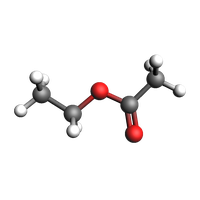
cs = ChemicalSystem(
    """
System
    Atoms
        O 1.48603879 -1.49561627 0.0
        C 1.29751002 -0.30552432 0.0
        O 0.07403584000000001 0.25228979 0.0
        C -1.02449892 -0.67494471 0.0
        C -2.30056502 0.12358769 0.0
        C 2.36905363 0.74347075 0.0
        H -0.9418758699999999 -1.31519741 0.88039373
        H -0.9418758699999999 -1.31519741 -0.88039373
        H -2.36617127 0.7582087199999999 0.88525259
        H -3.15628689 -0.55419212 0.0
        H -2.36617127 0.7582087199999999 -0.88525259
        H 3.34355252 0.26293272 0.0
        H 2.26362714 1.38098693 0.87932777
        H 2.26362714 1.38098693 -0.87932777
    End
End
"""
)
view(cs, guess_bonds=True, height=200, width=200)
Job settings: DFT and NMR
There are three calculations:
A DFT calculation with a main results file
adf.rkf. We must set theSave TAPE10input option. TheTAPE10file is later used by the$AMSBIN/nmrprogram.An
$AMSBIN/cplcalculation. This program modifiesadf.rkfAn
$AMSBIN/nmrcalculation. This program readsTAPE10and modifiesadf.rkf.
In the end, all results are stored on adf.rkf.
There is no PLAMS job for the $AMSBIN/cpl and $AMSBIN/nmr programs. Instead, we set up the calculation explicitly in the settings.runscript.postamble_lines option.
# DFT Settings
s = Settings()
s.input = AMS(Task="SinglePoint")
s.input.Engine = ADF()
s.input.Engine.Basis.Type = "TZ2P-J"
s.input.Engine.Basis.Core = "None"
s.input.Engine.Save = ["TAPE10"]
s.input.Engine.XC.GGA = "OPBE"
s.input.Engine.Symmetry = "NOSYM"
s.input.Engine.NumericalQuality = "Good"
from typing import Mapping, List


def get_cpl_script(s: Mapping) -> List[str]:
    ret = (
        ['"$AMSBIN/cpl" <<eor']
        + ["ADFFile adf.rkf"]
        + ["NMRCOUPLING"]
        + [f"  {k} {v}" for k, v in s.items()]
        + ["END"]
        + ["eor"]
        + [""]
    )
    return ret


def get_nmr_script(s: Mapping) -> List[str]:
    ret = (
        ['"$AMSBIN/nmr" <<eor']
        + ["ADFFile adf.rkf", "TAPE10File TAPE10"]
        + ["NMR"]
        + [f"  {k} {v}" for k, v in s.items()]
        + ["End"]
        + ["eor"]
        + [""]
    )
    return ret


cpl_settings = dict(RespAllAtomsOfType="H", PertAllAtomsOfType="H", fc="", ADFGUI="")
nmr_settings = dict(out="", adfgui="", AllAtomsOfType="H", u1k="best", calc="all")

s.runscript.postamble_lines = get_cpl_script(cpl_settings) + get_nmr_script(nmr_settings)
Inspect the job
job = AMSJob(settings=s, molecule=cs, name="ethyl_acetate_nmr")
print(job.get_input())  # DFT settings in the normal input (ethyl_acetate_nmr.in)
Task SinglePoint
Engine ADF
    Basis
        Type TZ2P-J
        Core None
    End
    Save TAPE10
    XC
        GGA OPBE
    End
... output trimmed ....
      H -0.94187587 -1.31519741 0.88039373
      H -0.94187587 -1.31519741 -0.88039373
      H -2.36617127 0.75820872 0.88525259
      H -3.15628689 -0.55419212 0
      H -2.36617127 0.75820872 -0.88525259
      H 3.34355252 0.26293272 0
      H 2.26362714 1.38098693 0.87932777
      H 2.26362714 1.38098693 -0.87932777
   End
End
print(job.get_runscript()) # post-processing utilities in the runscript
unset AMS_SWITCH_LOGFILE_AND_STDOUT
unset SCM_LOGFILE
AMS_JOBNAME="ethyl_acetate_nmr" AMS_RESULTSDIR=. $AMSBIN/ams --input="ethyl_acetate_nmr.in" < /dev/null

"$AMSBIN/cpl" <<eor
ADFFile adf.rkf
NMRCOUPLING
  RespAllAtomsOfType H
  PertAllAtomsOfType H
  fc
... output trimmed ....
  out
  adfgui
  AllAtomsOfType H
  u1k best
  calc all
End
eor
job.run();
[08.10|10:08:13] JOB ethyl_acetate_nmr STARTED
[08.10|10:08:13] JOB ethyl_acetate_nmr RUNNING
[08.10|10:13:54] JOB ethyl_acetate_nmr FINISHED
[08.10|10:13:54] JOB ethyl_acetate_nmr SUCCESSFUL
Results (basic)
Let’s see which NMR results are available on adf.rkf:
# job = AMSJob.load_external("/path/to/adf.rkf")   # to load a previous job
props = job.results.get_engine_properties()
nmr_keys = [x for x in props.keys() if "NMR" in x]
print(nmr_keys)
['NMR Coupling K const InputOrder', 'NMR Coupling J tens InputOrder', 'NMR Shielding Tensor InputOrder', 'NMR Coupling J const InputOrder', 'NMR Shieldings InputOrder', 'NMR Coupling K tens InputOrder']
import numpy as np
import matplotlib.pyplot as plt
from scm.plams.tools.postprocess_results import broaden_results

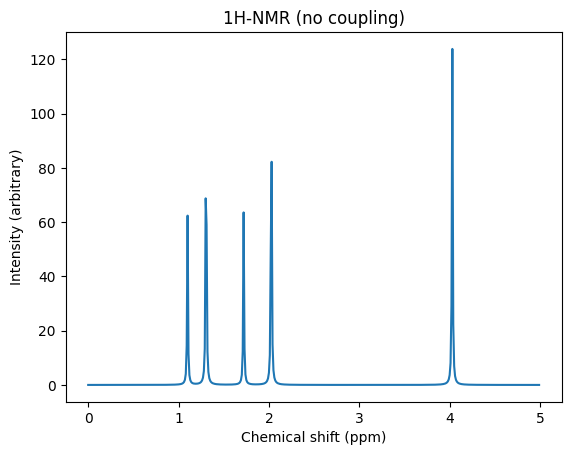
sigma_ref_h = 31.7
shieldings = np.array(props["NMR Shieldings InputOrder"])

chemical_shifts = sigma_ref_h - np.array(shieldings)

x, y = broaden_results(
    chemical_shifts,
    areas=np.ones(chemical_shifts.shape),  # weigh all peaks equally
    broadening_width=0.01,
    broadening_type="lorentzian",
    x_data=(0, 5, 0.01),  # x range and resolution
)

fig, ax = plt.subplots()
ax.set_title("1H-NMR (no coupling)")
ax.set_xlabel("Chemical shift (ppm)")
ax.set_ylabel("Intensity (arbitrary)")
ax.plot(x, y)
ax;
Conclusion
In this Python example you learned how to set up and run the NMR calculation.
For more detailed analysis, including multiplet splitting (coupling), see the GUI tutorial.
Recommendation: Use AMSspectra for further analysis.
See also
Python Script
#!/usr/bin/env python
# coding: utf-8

# ## Initial imports

from scm.base import ChemicalSystem
from scm.inputs import ADF, AMS
from scm.plams import AMSJob, Settings, view


# ## System

cs = ChemicalSystem(
    """
System
    Atoms
        O 1.48603879 -1.49561627 0.0
        C 1.29751002 -0.30552432 0.0
        O 0.07403584000000001 0.25228979 0.0
        C -1.02449892 -0.67494471 0.0
        C -2.30056502 0.12358769 0.0
        C 2.36905363 0.74347075 0.0
        H -0.9418758699999999 -1.31519741 0.88039373
        H -0.9418758699999999 -1.31519741 -0.88039373
        H -2.36617127 0.7582087199999999 0.88525259
        H -3.15628689 -0.55419212 0.0
        H -2.36617127 0.7582087199999999 -0.88525259
        H 3.34355252 0.26293272 0.0
        H 2.26362714 1.38098693 0.87932777
        H 2.26362714 1.38098693 -0.87932777
    End
End
"""
)


view(cs, guess_bonds=True, height=200, width=200, picture_path="picture1.png")


# ## Job settings: DFT and NMR
#
# There are three calculations:
#
# 1. A DFT calculation with a main results file ``adf.rkf``. We must set the ``Save TAPE10`` input option. The ``TAPE10`` file is later used by the ``$AMSBIN/nmr`` program.
#
# 2. An ``$AMSBIN/cpl`` calculation. This program *modifies* ``adf.rkf``
#
# 3. An ``$AMSBIN/nmr`` calculation. This program reads ``TAPE10`` and *modifies* ``adf.rkf``.
#
# In the end, all results are stored on ``adf.rkf``.
#
# There is no PLAMS job for the ``$AMSBIN/cpl`` and ``$AMSBIN/nmr`` programs. Instead, we set up the calculation explicitly in the ``settings.runscript.postamble_lines`` option.

# DFT Settings
s = Settings()
s.input = AMS(Task="SinglePoint")
s.input.Engine = ADF()
s.input.Engine.Basis.Type = "TZ2P-J"
s.input.Engine.Basis.Core = "None"
s.input.Engine.Save = ["TAPE10"]
s.input.Engine.XC.GGA = "OPBE"
s.input.Engine.Symmetry = "NOSYM"
s.input.Engine.NumericalQuality = "Good"


from typing import Mapping, List


def get_cpl_script(s: Mapping) -> List[str]:
    ret = (
        ['"$AMSBIN/cpl" <<eor']
        + ["ADFFile adf.rkf"]
        + ["NMRCOUPLING"]
        + [f"  {k} {v}" for k, v in s.items()]
        + ["END"]
        + ["eor"]
        + [""]
    )
    return ret


def get_nmr_script(s: Mapping) -> List[str]:
    ret = (
        ['"$AMSBIN/nmr" <<eor']
        + ["ADFFile adf.rkf", "TAPE10File TAPE10"]
        + ["NMR"]
        + [f"  {k} {v}" for k, v in s.items()]
        + ["End"]
        + ["eor"]
        + [""]
    )
    return ret


cpl_settings = dict(RespAllAtomsOfType="H", PertAllAtomsOfType="H", fc="", ADFGUI="")
nmr_settings = dict(out="", adfgui="", AllAtomsOfType="H", u1k="best", calc="all")

s.runscript.postamble_lines = get_cpl_script(cpl_settings) + get_nmr_script(nmr_settings)


# ## Inspect the job

job = AMSJob(settings=s, molecule=cs, name="ethyl_acetate_nmr")
print(job.get_input())  # DFT settings in the normal input (ethyl_acetate_nmr.in)


print(job.get_runscript())  # post-processing utilities in the runscript


job.run();


# ## Results (basic)
#
# Let's see which NMR results are available on adf.rkf:

# job = AMSJob.load_external("/path/to/adf.rkf")   # to load a previous job
props = job.results.get_engine_properties()
nmr_keys = [x for x in props.keys() if "NMR" in x]
print(nmr_keys)


import numpy as np
import matplotlib.pyplot as plt
from scm.plams.tools.postprocess_results import broaden_results

sigma_ref_h = 31.7
shieldings = np.array(props["NMR Shieldings InputOrder"])

chemical_shifts = sigma_ref_h - np.array(shieldings)

x, y = broaden_results(
    chemical_shifts,
    areas=np.ones(chemical_shifts.shape),  # weigh all peaks equally
    broadening_width=0.01,
    broadening_type="lorentzian",
    x_data=(0, 5, 0.01),  # x range and resolution
)

fig, ax = plt.subplots()
ax.set_title("1H-NMR (no coupling)")
ax.set_xlabel("Chemical shift (ppm)")
ax.set_ylabel("Intensity (arbitrary)")
ax.plot(x, y)
ax;
ax.figure.savefig("picture2.png")


# ## Conclusion
#
# In this Python example you learned how to set up and run the NMR calculation.
#
# For more detailed analysis, including multiplet splitting (coupling), see the GUI tutorial.
#
# **Recommendation**: Use AMSspectra for further analysis.