
Coformer Screening for Cocrystal Formation
Cocrystallization is a commonly-used method employed in pharmaceutical design to improve the solubility or stability of active ingredients. Experimental determination of suitable cocrystallization conditions is typically quite time-consuming as different synthesis routes are evaluated. The use of virtual pre-screening is therefore quite appealing to narrow down suitable coformer candidates.
In this tutorial, we will showcase such a coformer screening for itraconazole, a prominent antimycotic.
Create a New Compound
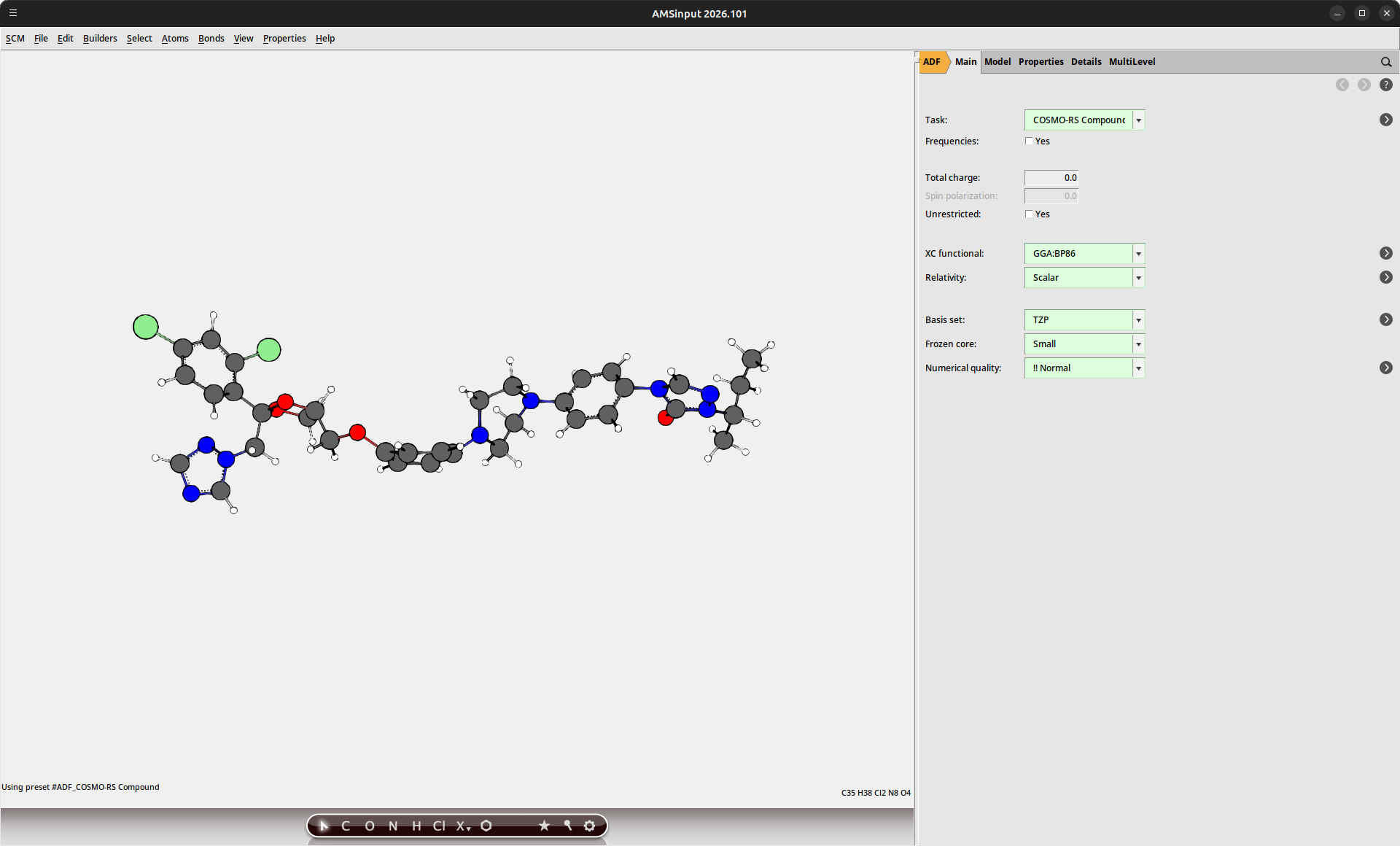
As a first step, we will calculate the electrostatic profile of itraconazole. This will provide the required parameters for the COSMO-RS calculation.
O=C1N(/N=C\N1c2ccc(cc2)N7CCN(c6ccc(OC[C@@H]3O[C@](OC3)(c4ccc(Cl)cc4Cl)Cn5ncnc5)cc6)CC7)C(C)CC and select OKItraconazoleThe COSMO-RS compound task will perform a geometry optimization of the molecule. A COSKF file will then be produced for the optimized geometry, which contains the required COSMO-RS parameters.
Screening Coformers
Once the itraconazole calculation has finished, we can add the new compound to our COSMO-RS workspace.
Itraconazole.coskf file that was created in the previous stepFor the coformers, we will use compounds from the included CRS database. On account of the basic nature of the itraconazole, a series of acidic partner molecules was considered here.
Tartaric acid in the search bar. Select the compound from the list and click the OK button to add it to the workspace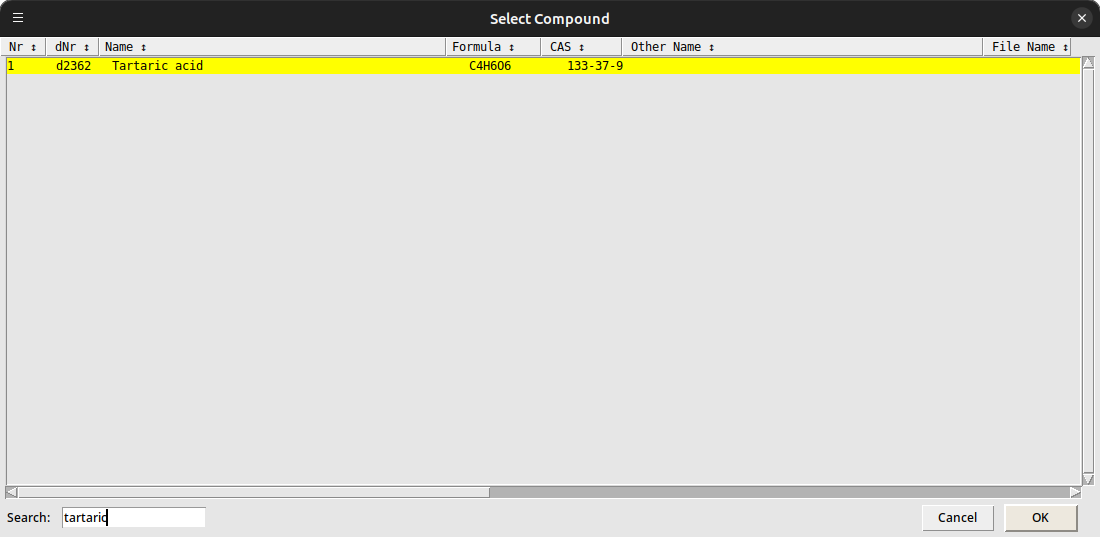
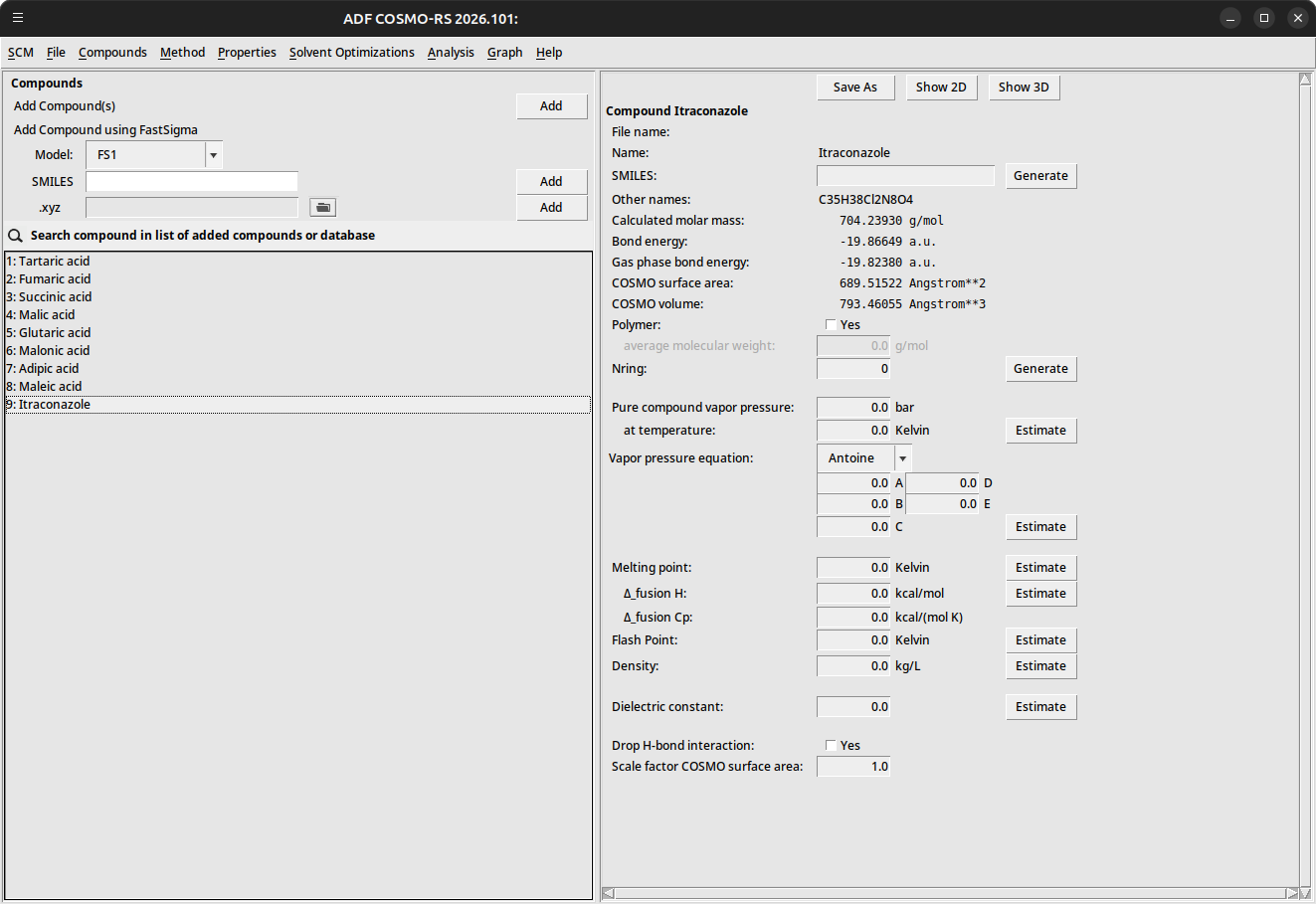
For each coformer, we can predict the stability of the binary mixture with itraconazole. A trimeric molecular crystal will be considered here, where 2 itraconazole molecules coordinate to each coformer. (This is the expected ratio based on the hydrogen bonding structure of the acid-base pairs, and has been verified experimentally.[1])
Tartaric acid by selecting the compound from the drop-down menuItraconazoleBoth a graph and table containing the mixture properties will be generated.
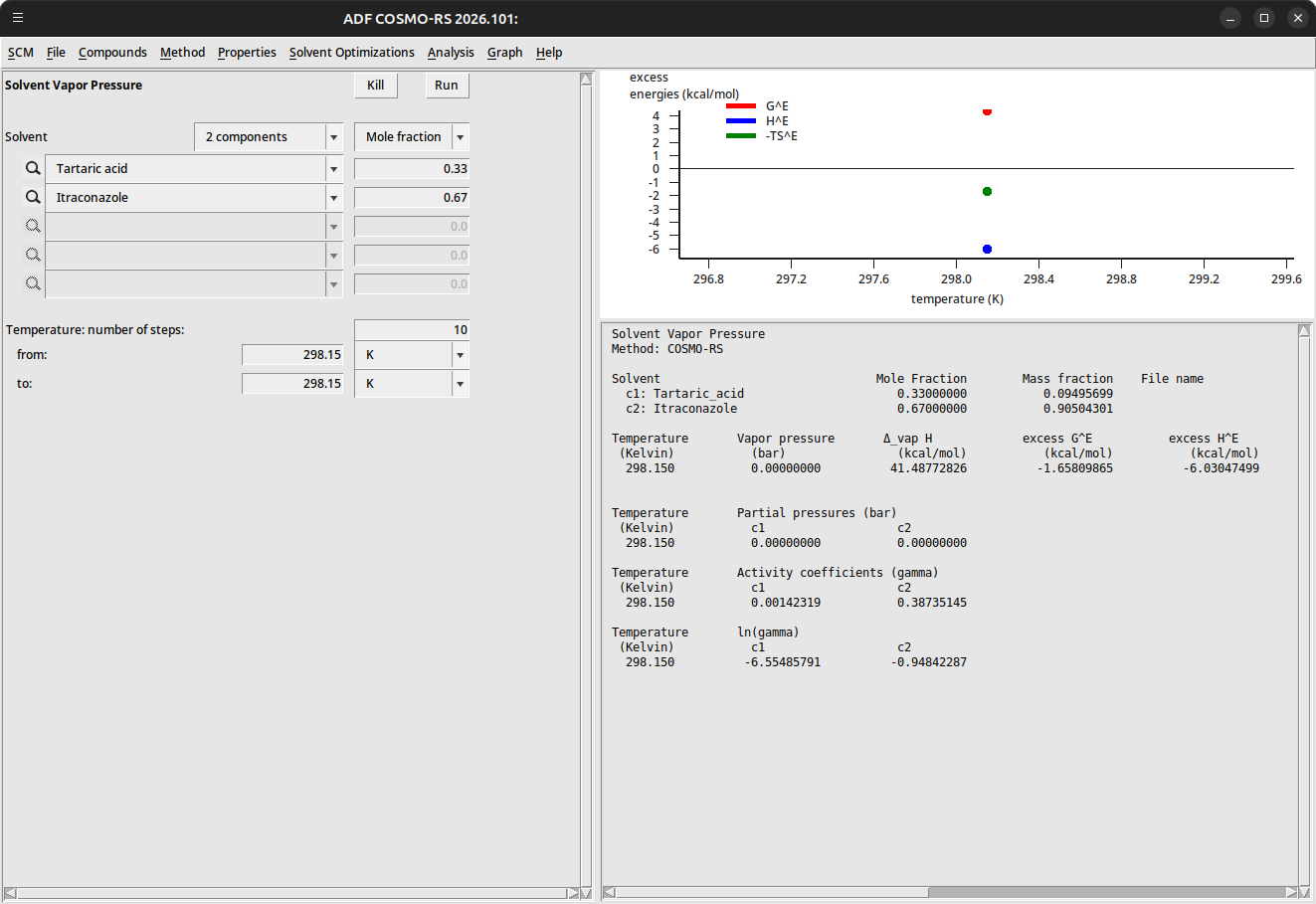
We can repeat this calculation for each of the coformers in order to compare the cocrystal affinities. COSMO-RS predicts the excess free energy and enthalpy for the coformer mixture. This excess energy quantifies the stability of the coformer blend relative to the pure compounds. Large excess energies indicate favorable interactions between the itraconazole and the acid, thereby increasing the likelihood for the compounds to coprecipitate.
Results
An overview of the excess mixture energies for each of the coformers is given in the figure below.
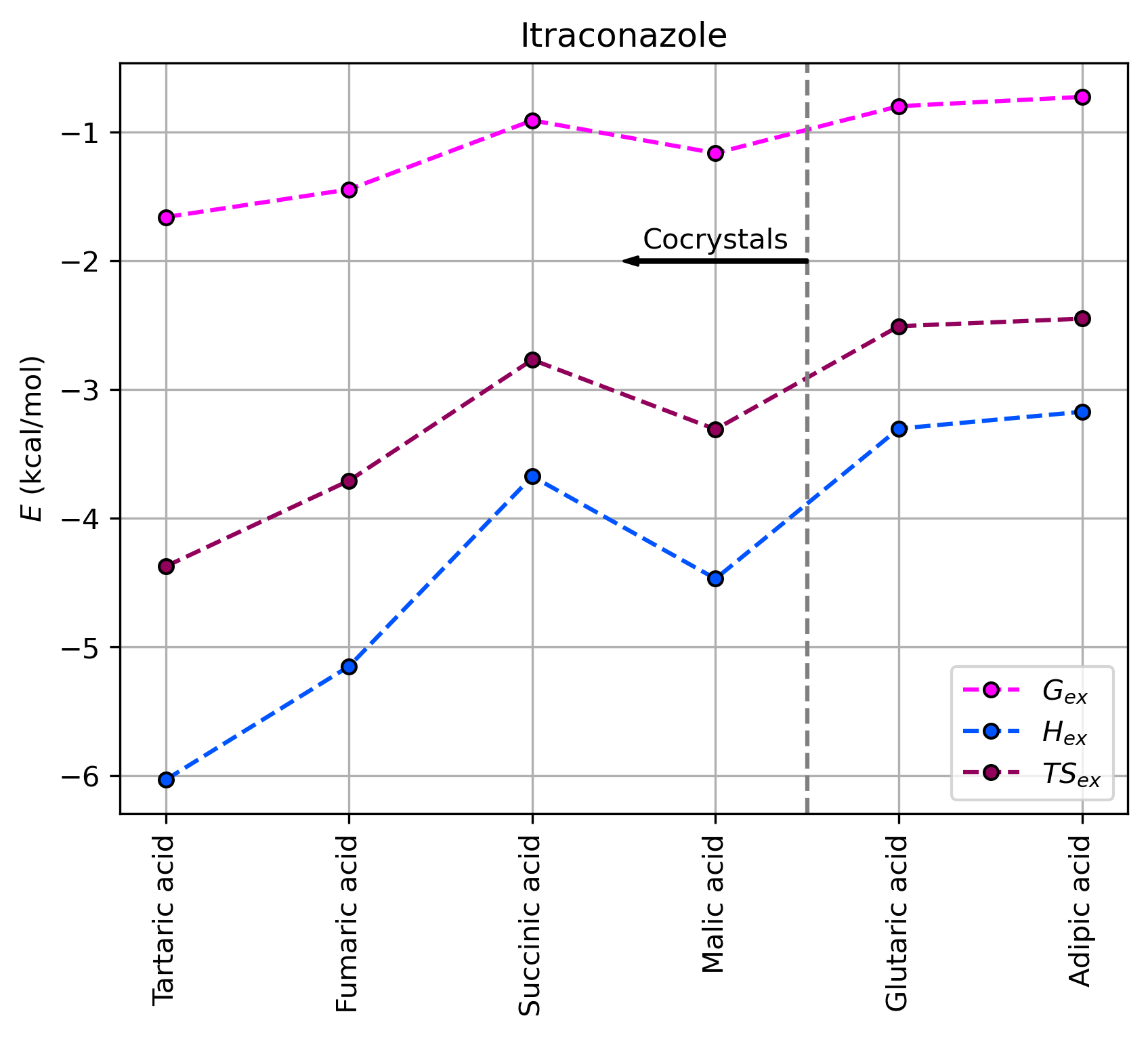
Fig. 56 Comparison of excess free energy and enthalpy for 2:1 itraconazole:coformer mixtures predicted by COSMO-RS at 298.15K. Cocrystals were experimentally observed for the lowest 4 coformers
The 4 coformers with the highest excess energy have been experimentally reported to form cocrystals. The excess energy (either the enthalpy or free energy) can therefore be considered as a candidate indicator for cocrystallization.
The energies can be used to rank coformer candidates, preferring large excess energies. Because COSMO-RS calculations take into account both electrostatic interactions and geometric factors, these predictions are considerably more reliable than using simple metrics such as the pH/pKa[1]
A cocrystallization boundary could be defined in the figure, situated around a free energy of 0.85 kcal/mol. Coformers with excess free energies above this threshold would then be expected to deposit as pure compounds. Deviations from a strict boundary are expected to occur as our predictions focus only on the thermodynamics: process kinetics may affect cocrystallization depending on the chosen synthesis route
The cocrystallization threshold cannot be predicted a priori as crystallization kinetics are omitted
These results indicate that COSMO-RS is preferably used to screen candidate coformers with strong tendencies to affiliate with the active pharmaceutical compound. These candidates are expected to be located well within the cocrystallization regime. Different experimental cocrystallization methods can then be tested to evaluate kinetically viable routes for cocrystal synthesis.